
Your AI Agent Depends on Six Layers — Here's Which Ones Won't Last
Updated
•2 min read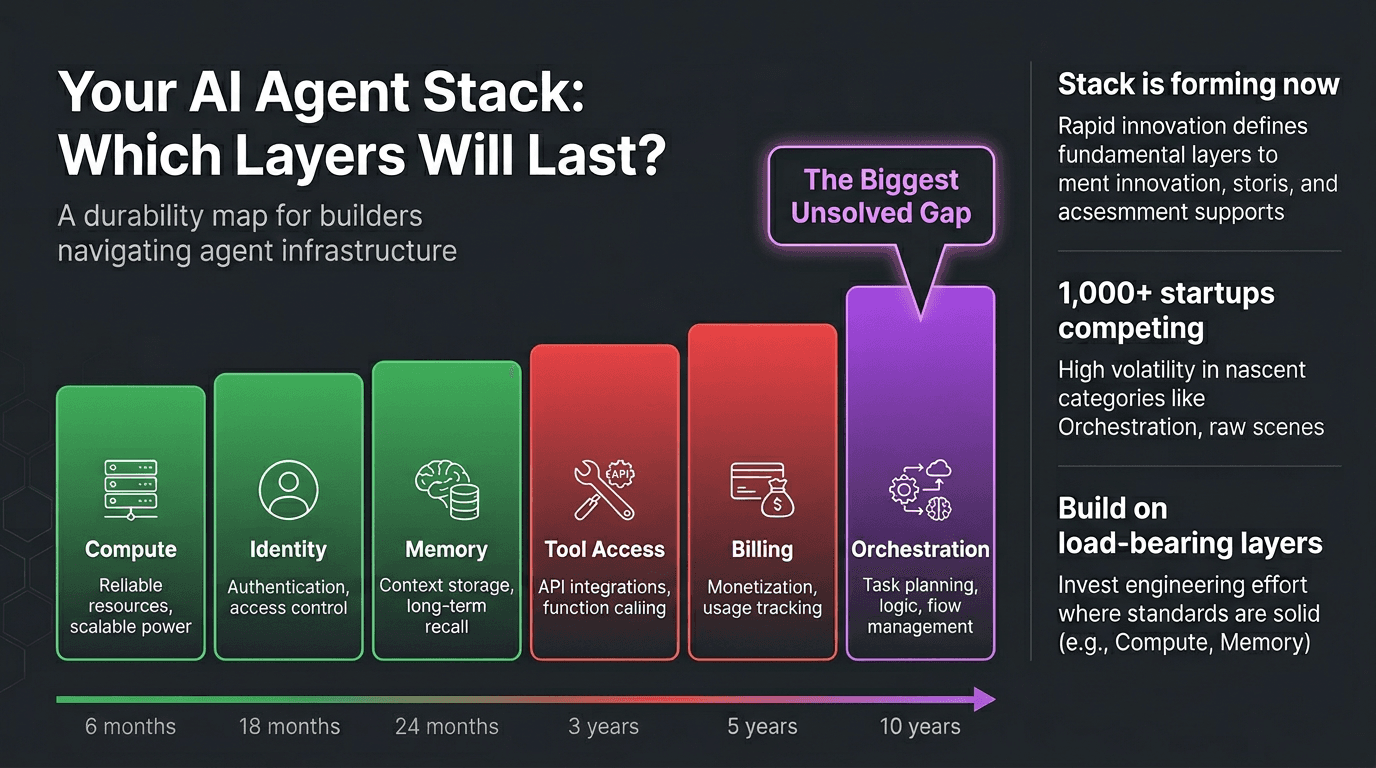
Your AI Agent Depends on Six Layers — Here's Which Ones Won't Last
Main Thesis
A new infrastructure stack is forming beneath AI agents, and most builders can't distinguish which layers are durable from which are temporary stopgaps. Nate argues that understanding this stack early is a competitive advantage — mirroring how early readers of the cloud and API-first transitions built defining companies, while late adapters paid in migration costs and lost time.
The Mental Model
- The right analogy is system calls, not Lego bricks — these layers are fundamental OS-level primitives for AI agents, not modular optional components.
- The stack is being built for AI agents as the primary user, not humans.
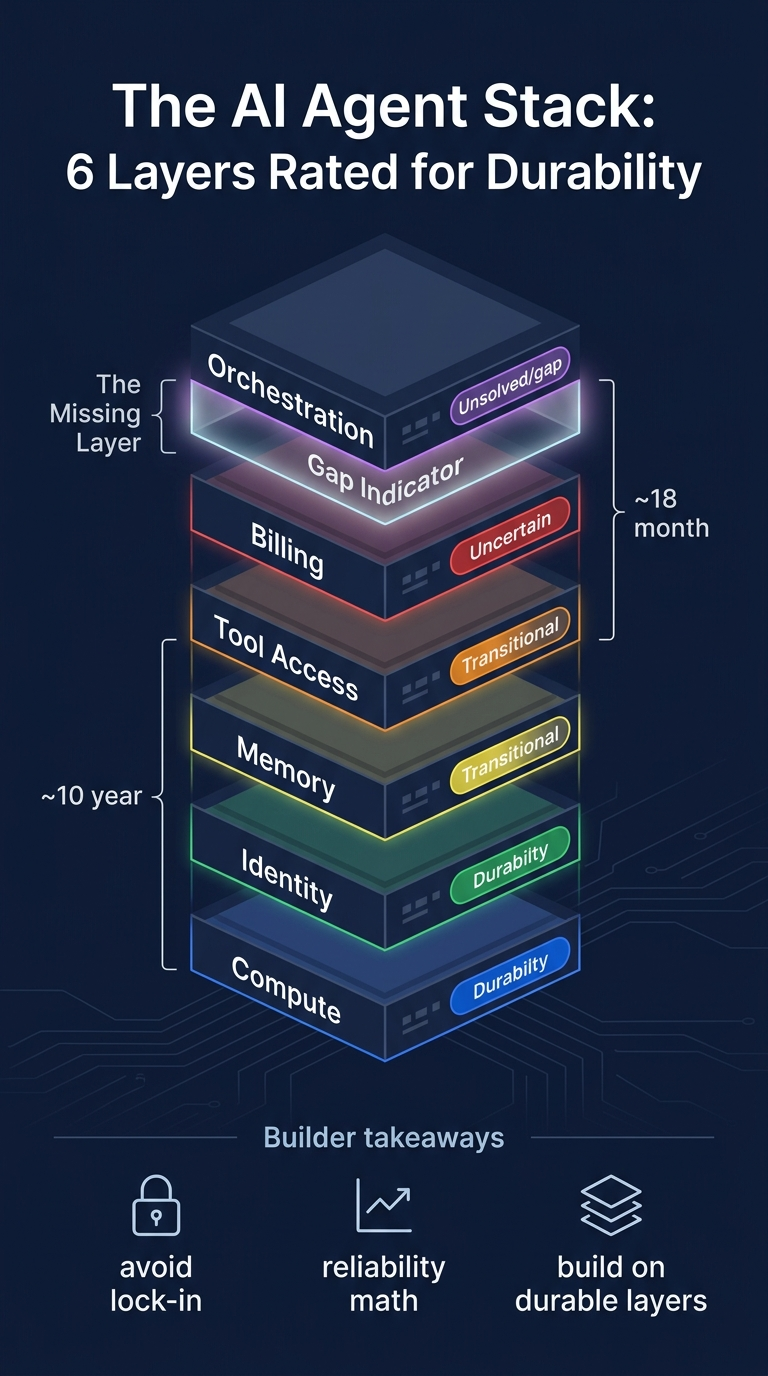
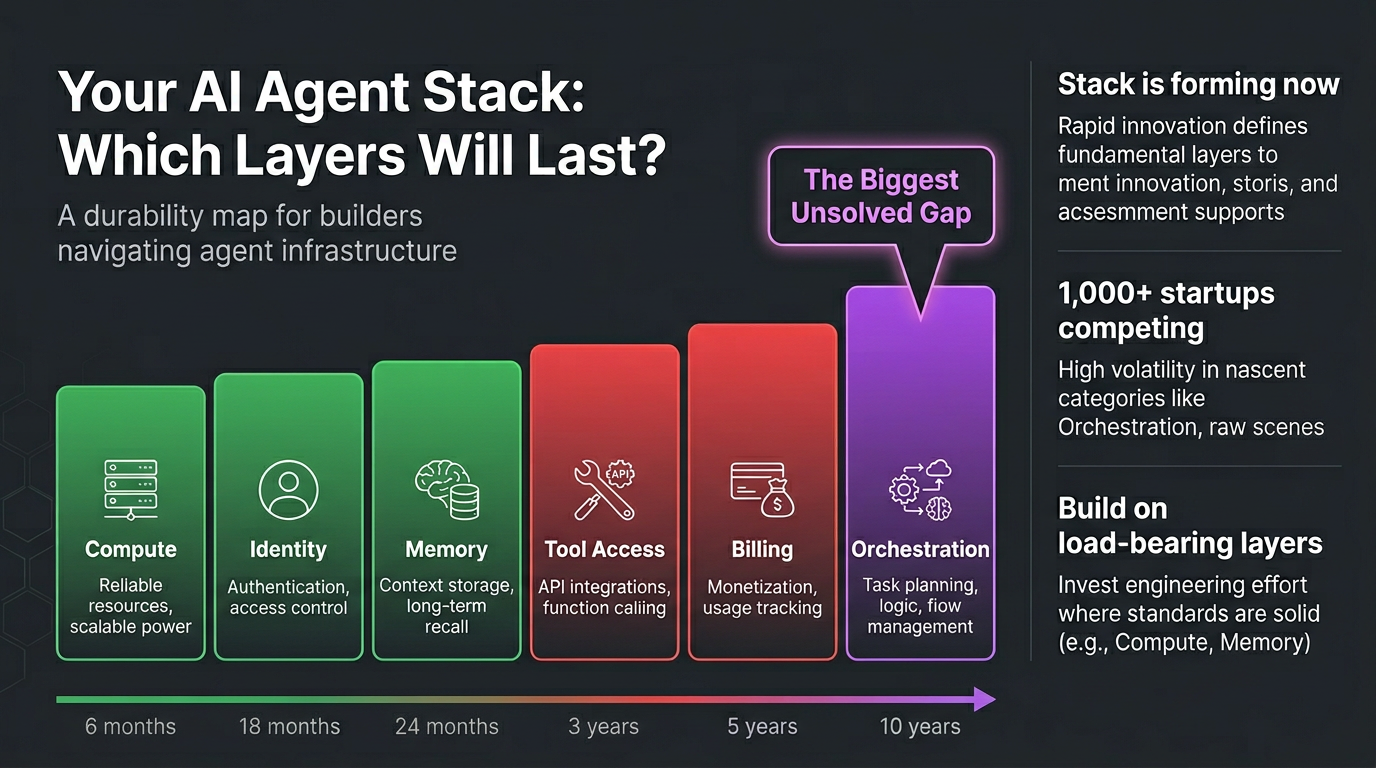
The Six Layers (with durability ratings)
- Compute — How agents access processing power
- Identity — How agents authenticate and are recognized
- Memory — How agents retain and retrieve context
- Tool Access — How agents interact with external services
- Billing — How agent-driven actions are metered and charged
- Orchestration — How agents are coordinated and managed
Each layer is assessed for longevity — some are described as load-bearing walls lasting a decade, others as transitional workarounds agents will outgrow within 18 months.
Key Finding: The Biggest Gap
- Orchestration is identified as the most critical unsolved problem — the next infrastructure-defining opportunity — and no one has cracked it yet.
- Several layers that will define the next infrastructure-scale company don't exist yet.
Practical Takeaways
- Builders should audit which layers they're dependent on and assess their durability.
- Avoid transitional lock-in — building deeply on layers likely to be replaced soon.
- Focus on reliability math when designing agent systems.
- Develop builder skills aligned with the durable layers, not the temporary ones.
- Over 1,000 startups and hundreds of millions in VC are already in this space — the window to get ahead of the stack is narrowing.
Bottom Line
The agent infrastructure stack is real, it's forming now, and the builders who can read it accurately will define the next era of AI — just as cloud-native builders defined the last one.