
Top AI Papers of the Week
Top AI Papers of the Week (February 16–22, 2026)
From Elvis Saravia's AI Newsletter
Overview
This week's roundup covers 10 significant AI research papers spanning agent delegation, social dynamics, memory management, personalization, benchmarking, and reasoning efficiency. A recurring theme is the gap between what AI systems appear capable of and what they can reliably do in real-world, multi-session, or complex agentic settings.
1. Intelligent AI Delegation — Google DeepMind
Google DeepMind introduces a comprehensive framework treating delegation not as a simple task handoff, but as a sequence of decisions: whether to delegate, how to instruct, and how to verify and integrate outputs.
- Adaptive delegation: Dynamic, real-time adaptation rather than static heuristics, with resilient failure management.
- Trust calibration: Formal trust models accounting for capability uncertainty, task complexity, and historical performance — preventing both over- and under-delegation.
- Verification protocols: Confidence-aware acceptance criteria and fallback mechanisms before AI outputs are integrated.
- Multi-agent chains: Extends to AI-to-AI delegation networks with accountability tracking and authority propagation.
Takeaway: Production AI deployments need structured delegation frameworks — blind trust in agent outputs compounds errors at scale.
2. Emergent Socialization in AI Agent Society — Moltbook Study
Researchers studied Moltbook, the largest AI-only social network with millions of LLM-driven agents, finding that scale and interaction density alone do not produce meaningful social dynamics.
- Global semantic content stabilises quickly, but individual agents maintain diversity without converging.
- Agents show strong individual inertia and minimal adaptive response to interaction partners.
- No stable social structures, consensus, or genuine social learning emerged.
- Key conclusion: Persistent shared memory is a prerequisite for real social dynamics — without it, population size is irrelevant.
Takeaway: Current LLM architectures lack the mechanisms for genuine social learning; memory architecture is more important than scale.
3. Lossless Context Management (LCM)
LCM is a deterministic architecture for LLM memory, tested via the coding agent Volt on the OOLONG benchmark against Claude Code (Opus 4.6).
- Recursive context compression: Older messages compacted into a hierarchical summary DAG with lossless pointers — no information is lost.
- Recursive task partitioning: Engine-managed parallel primitives (LLM-Map) replace model-written loops for deterministic execution.
- Three-level escalation: Summary nodes → compact file references → guaranteed convergence mechanism.
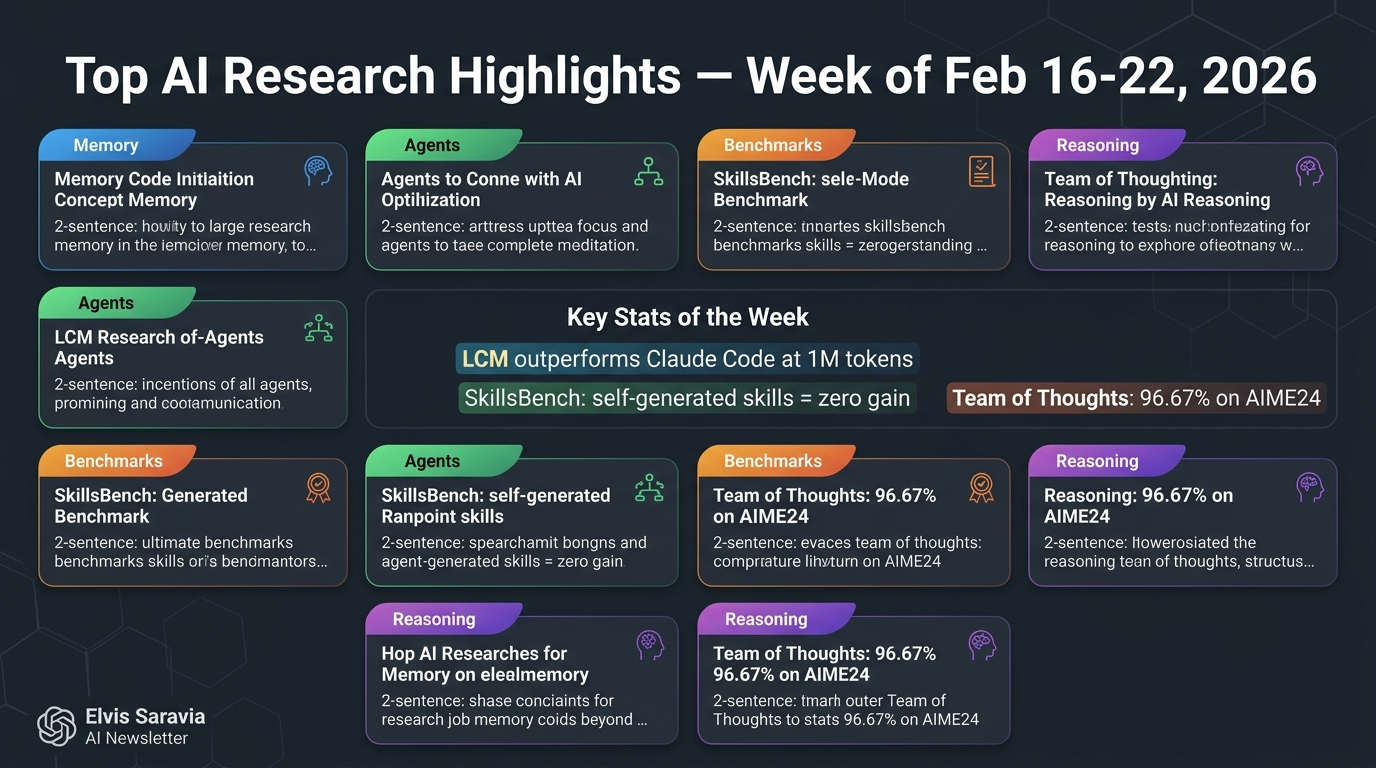
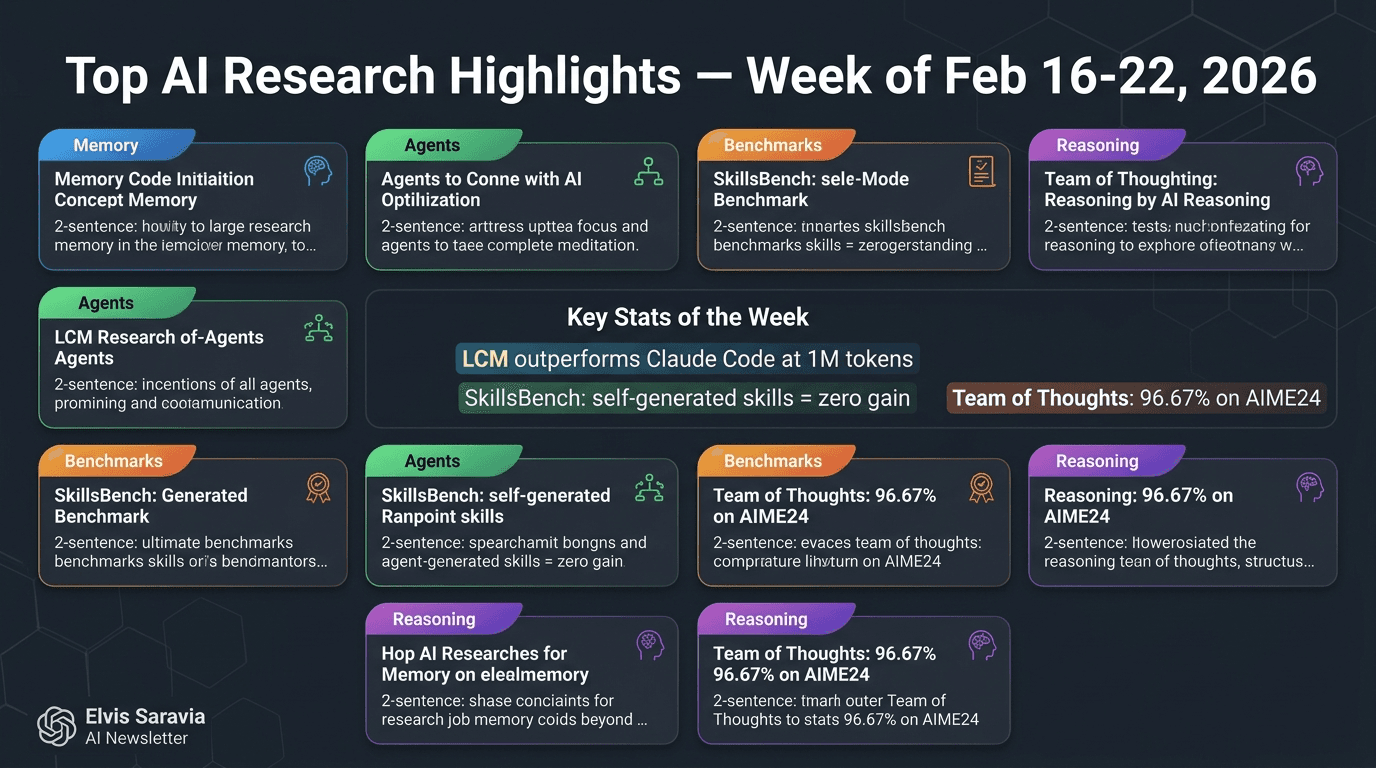
- Results: Volt+LCM scores +29.2 avg improvement vs. +24.7 for Claude Code; advantage grows to +51.3 vs. +47.0 at 1M tokens.
Takeaway: Deterministic context management outperforms native file-system access at extreme context lengths — critical for long-horizon coding agents.
4. GLM-5 — Zhipu AI
GLM-5 is a foundation model targeting agentic software engineering rather than isolated code generation.
- Asynchronous agent RL: Decouples trajectory generation from policy optimisation, enabling parallel scaling and faster experimentation.
- DSA (Distributed Sparse Attention): Reduces long-context computational overhead without quality loss.
- Agentic focus: Handles project-level context, multi-file edits, and iterative development cycles.
- Strong benchmark results on end-to-end tasks including specification understanding, implementation, testing, and debugging.
Takeaway: The shift from vibe coding to agentic engineering requires models designed for full project-level context, not just completion tasks.
5. MemoryArena
MemoryArena benchmarks whether agents can use retrieved memory to take correct actions across multiple interconnected sessions — not just recall it.
- Covers web navigation, constrained planning, information retrieval, and logical reasoning with interdependent sessions.
- Models near-saturating existing benchmarks (e.g., LoCoMo) perform poorly on MemoryArena.
- Exposes a critical gap: retrieval accuracy ≠ actionable memory use.
Takeaway: Existing memory benchmarks overestimate real agent capability. Developers should evaluate memory systems on downstream decision quality, not just retrieval.
6. MAPLE
MAPLE proposes decomposing memory, learning, and personalization into three specialised sub-agents, each operating at different timescales.
- Memory: Storage and retrieval infrastructure.
- Learning: Asynchronous offline distillation of interaction history — avoids flooding the active context window.
- Personalization: Context-budget-aware injection of the most relevant learned knowledge in real time.
- Results: +14.6% improvement in personalisation scores; trait incorporation increases from 45% to 75% (validated on MAPLE-Personas benchmark).
Takeaway: Treating memory, learning, and personalisation as a unified capability is inefficient — specialised sub-agents operating asynchronously deliver substantially better results.
7. SkillsBench
SkillsBench evaluates whether LLM agents can generate their own procedural knowledge across 86 tasks in 11 domains (7,308 trajectories, 7 agent-model configs).
- Curated skills boost performance: +16.2pp average pass rate; domain effects range from +4.5pp (Software Engineering) to +51.9pp (Healthcare).
- Self-generated skills provide zero benefit: Models bootstrapping their own skills show no improvement over having no skills at all.
- Focused beats comprehensive: 2–3 focused modules outperform broad documentation.
- Smaller models close the gap: Well-curated skills allow smaller models to match larger models without skills — major cost implications.
Takeaway: Self-improving agent architectures that assume models can generate their own procedural knowledge are fundamentally flawed based on current evidence.
8. LongCLI-Bench
Benchmarks AI agents on complex, extended CLI tasks across 20 demanding scenarios (initial development, feature expansion, error resolution, optimisation).
- Leading agents succeed less than 20% of the time.
- Most failures occur early in task execution.
- Human-agent collaboration (plan injection + interactive guidance) yields far greater improvements than automated self-correction alone.
Takeaway: CLI-based agentic tasks remain largely unsolved; human-in-the-loop guidance is more effective than autonomous self-repair.
9. CogRouter
CogRouter enables adaptive reasoning depth by dynamically selecting from four hierarchical cognitive levels at each step — from instinctive responses to strategic planning.
- Uses confidence-aware advantage reweighting during training.
- Qwen2.5-7B + CogRouter: 82.3% success rate on agentic benchmarks, outperforming larger models while consuming fewer tokens by skipping heavy reasoning on routine steps.
Takeaway: Not every step needs deep reasoning — dynamic cognitive routing delivers better performance and lower cost simultaneously.
10. Team of Thoughts
A multi-agent framework for efficient test-time scaling through orchestrated tool calling, using a calibrated orchestrator to coordinate agents with different capabilities.
- Agents perform self-assessment; orchestrator identifies superior coordination models.
- Results: 96.67% on AIME24, 72.53% on LiveCodeBench — substantially exceeding homogeneous baselines.
Takeaway: Heterogeneous agent orchestration with calibrated coordination dramatically outperforms teams of identical agents on hard reasoning and coding tasks.
Key Cross-Cutting Themes
| Theme | Papers |
| Memory architecture is foundational | LCM, Moltbook, MAPLE, MemoryArena |
| Benchmarks overestimate real capability | MemoryArena, SkillsBench, LongCLI-Bench |
| Specialisation beats monolithic design | MAPLE, CogRouter, Team of Thoughts |
| Human oversight still critical | Intelligent Delegation, LongCLI-Bench |
| Smaller models + good tooling = competitive | SkillsBench, CogRouter |
Note: Arxiv links above are placeholders — exact paper URLs were not included in the newsletter. Check arxiv.org or the original newsletter at nlp.elvissaravia.com for direct paper links.