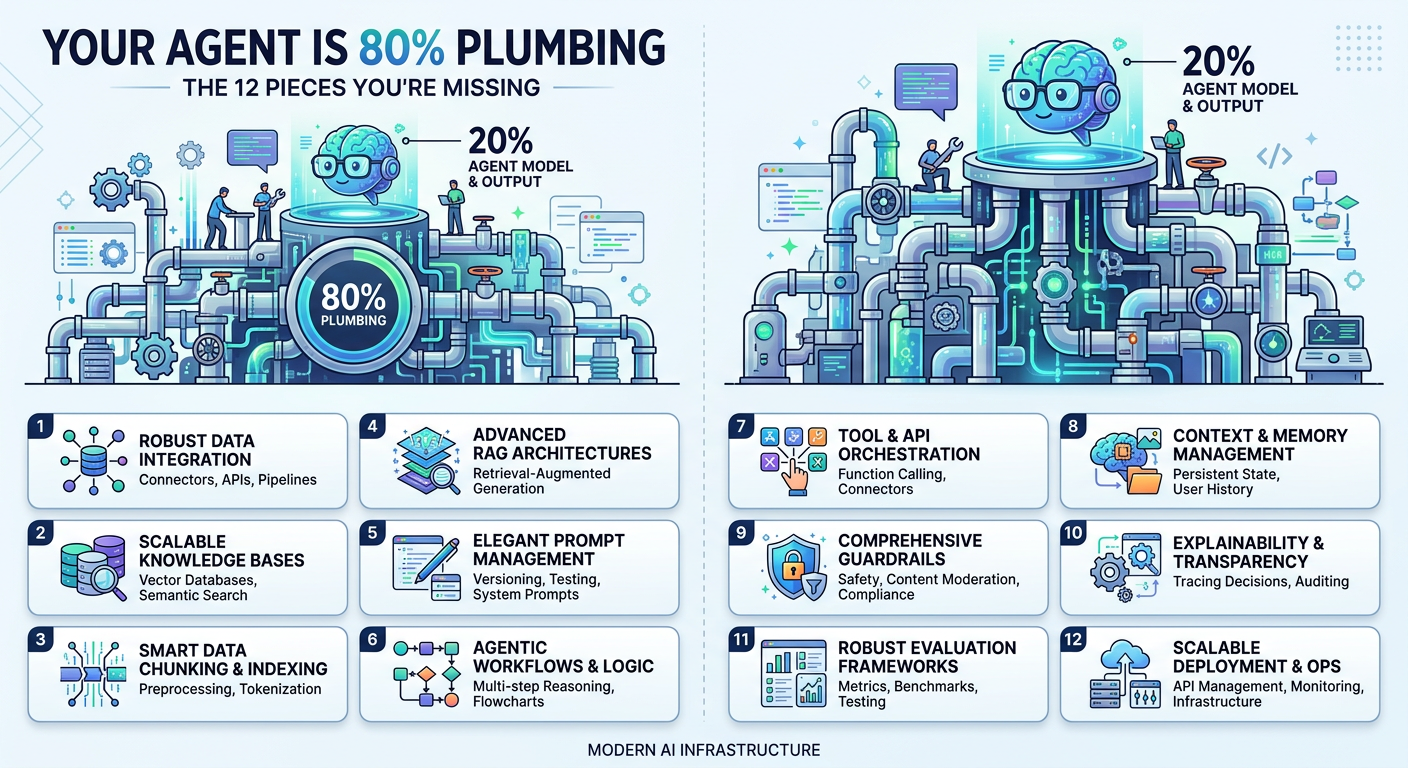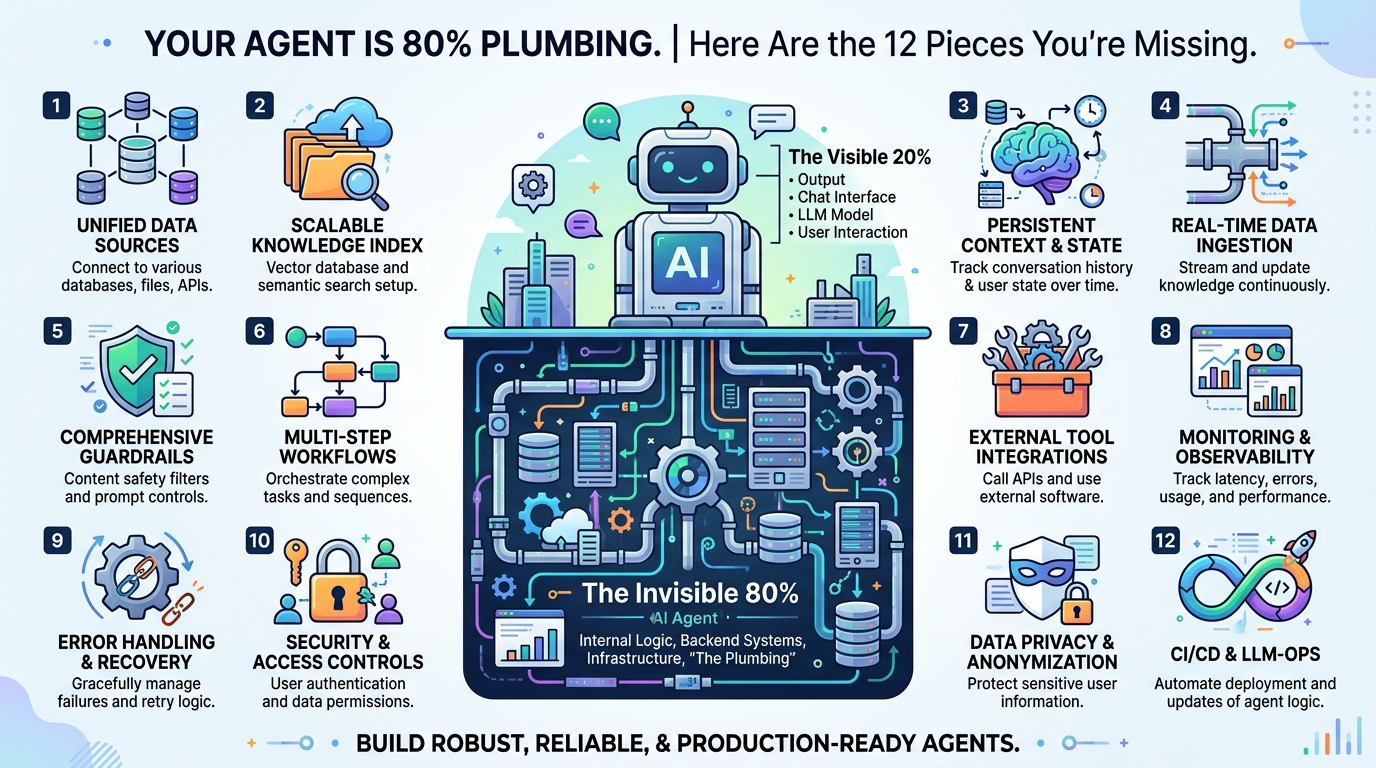

Your Agent Is 80% Plumbing. Here Are the 12 Pieces You're Missing.
Updated
•4 min read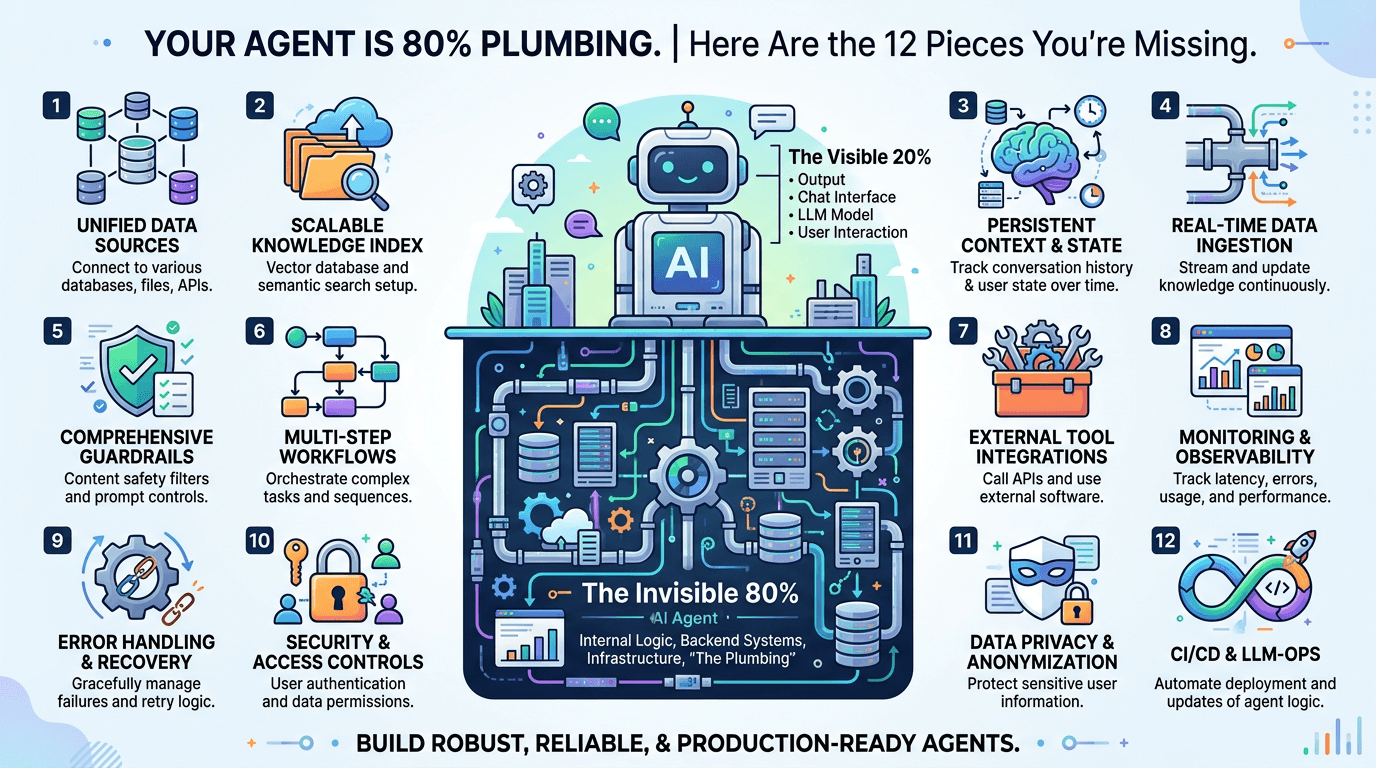
{
  "summary": "# Your Agent Is 80% Plumbing — Summary\n\n## Main Thesis\nAnthropic accidentally leaked the full source code of **Claude Code** (1,902 files, 512,000+ lines across 29 subsystems) by failing to exclude a source map file from an npm package. While most coverage focused on novelty features (a Tamagotchi pet, unreleased voice mode, 44 feature flags), the author digs into the **infrastructure underneath** — arguing that the LLM call itself is only ~20% of what makes an agentic AI system work. The other **80% is 'plumbing'**: the boring, unsexy infrastructure that separates a demo from a production system.\n\n## Key Findings\n\n### The Leak Meta-Lesson\n- This was Anthropic's second major accidental exposure in one week, highlighting how **AI-assisted development velocity is outrunning operational discipline**.\n- The leak was caused by a simple oversight — not excluding source maps from an npm package — a cautionary tale for any team shipping fast.\n\n### The 12 Infrastructure Primitives\nThe article identifies **12 foundational infrastructure components** that Claude Code runs on, prioritized by when you need to build them (Day 1 → Week 1 → Month 1):\n1. **Session persistence** — surviving crashes without losing state\n2. **Permission pipelines** — tools shouldn't run without explicit authorization\n3. **Context budget management** — preventing context window overflow and cost spirals\n4. **Tool registries** — organized, discoverable tool management\n5. **Security stacks** — an 18-module stack just for a single shell command\n6. **Error recovery** — graceful failure handling\n7. *(Plus 6 additional primitives covered in the full paid post)*\n\n### The Security Depth\n- Anthropic uses an **18-module security stack** just to handle a single shell command — illustrating the depth of production-grade agent security.\n- Key concerns addressed: permissions, crash recovery, token budgets, and session persistence at scale.\n\n### Community Validation\n- Within hours of the leak, developers **ported the entire harness to Python and Rust**, confirming these patterns are **not Anthropic-specific** — they are structural requirements of any real-world agent system.\n\n## Why Most Agents Fail in Production\nThe article argues that nearly every "how to build agents" tutorial stops at the demo stage — get the prompt right, wire up tool calling, ship it. This leaves developers blindsided by:\n- Sessions that don't survive crashes\n- Tools running without permission checks\n- Context windows overflowing unexpectedly\n- Costs spiraling out of control\n- No observability into what went wrong\n\n## Practical Takeaways\n- **Audit your agent architecture** against all 12 primitives before going to production.\n- The article offers an **architecture audit prompt** that interviews you about your system and returns a gap analysis.\n- A **free skill package** is provided for Claude Code and OpenAI Codex that reads your codebase and identifies what infrastructure is missing.\n- Think of your agent as a **distributed system**, not a fancy chatbot — invest in the plumbing first.",
  "image_prompt_portrait": "A tall 1080x1920 infographic with a dark navy and electric blue color scheme, titled 'Your Agent Is 80% Plumbing' in bold white sans-serif text at the top. Below the title, a large vertical pipeline diagram runs down the center of the image, styled like industrial plumbing pipes with glowing neon blue connections. Each pipe section is labeled with one of the 12 infrastructure primitives: Session Persistence, Permission Pipelines, Context Budget Management, Tool Registries, Security Stack, Error Recovery, and others, each in a bright accent color badge. At the top of the pipeline, a small glowing brain icon labeled 'LLM Call — 20%' feeds into the system. At the bottom, a stable glowing server rack labeled 'Production System' receives all the flows. A sidebar callout box reads '18-module security stack for ONE shell command'. A small warning badge near the top states 'Demo ≠ Production'. Clean, technical, infographic style, modern data visualization aesthetic, no people, high contrast, professional.",
  "image_prompt_landscape": "A wide 2160x1216 infographic in a dark charcoal and cyan color scheme titled 'The 12 Agent Infrastructure Primitives' in large bold white text top-left. The layout is a horizontal grid of 12 icon cards arranged in three rows of four, each card containing a minimalist icon and label for one primitive: Session Persistence (clock icon), Permission Pipelines (lock icon), Context Budget Management (gauge icon), Tool Registries (toolbox icon), Security Stack (shield icon), Error Recovery (refresh arrow icon), and 6 more. Cards are color-coded by build priority: green for Day 1, yellow for Week 1, orange for Month 1. On the right third of the image, a bold callout stat reads '80% of Claude Code is plumbing' with a pie chart showing 20% LLM in blue and 80% infrastructure in cyan. Below that, a secondary callout reads '512,000 lines | 29 subsystems | $2.5B ARR'. Bottom strip contains a timeline bar labeled 'Demo → Staging → Production' with gap markers. Clean technical infographic style, no people, modern sans-serif fonts, high contrast professional design."
}