Top AI Papers of the Week
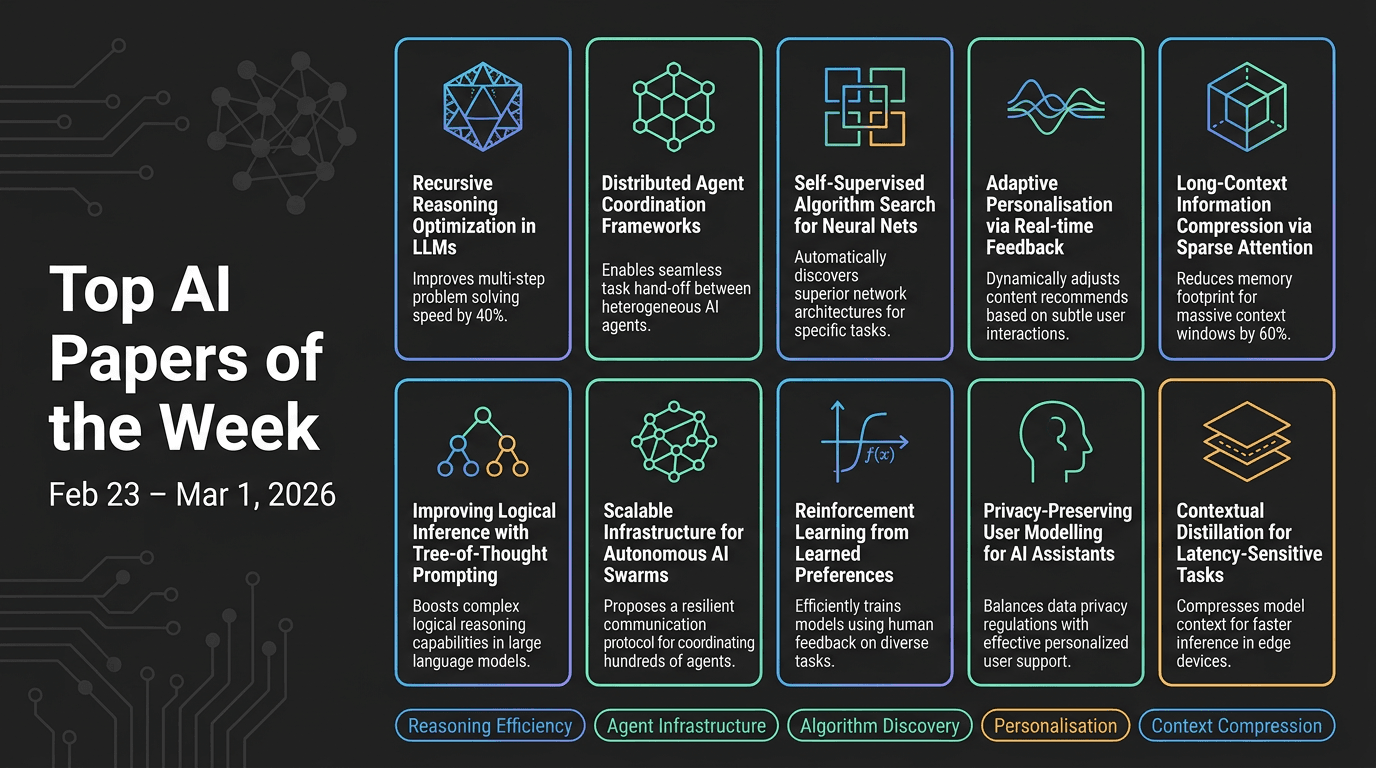
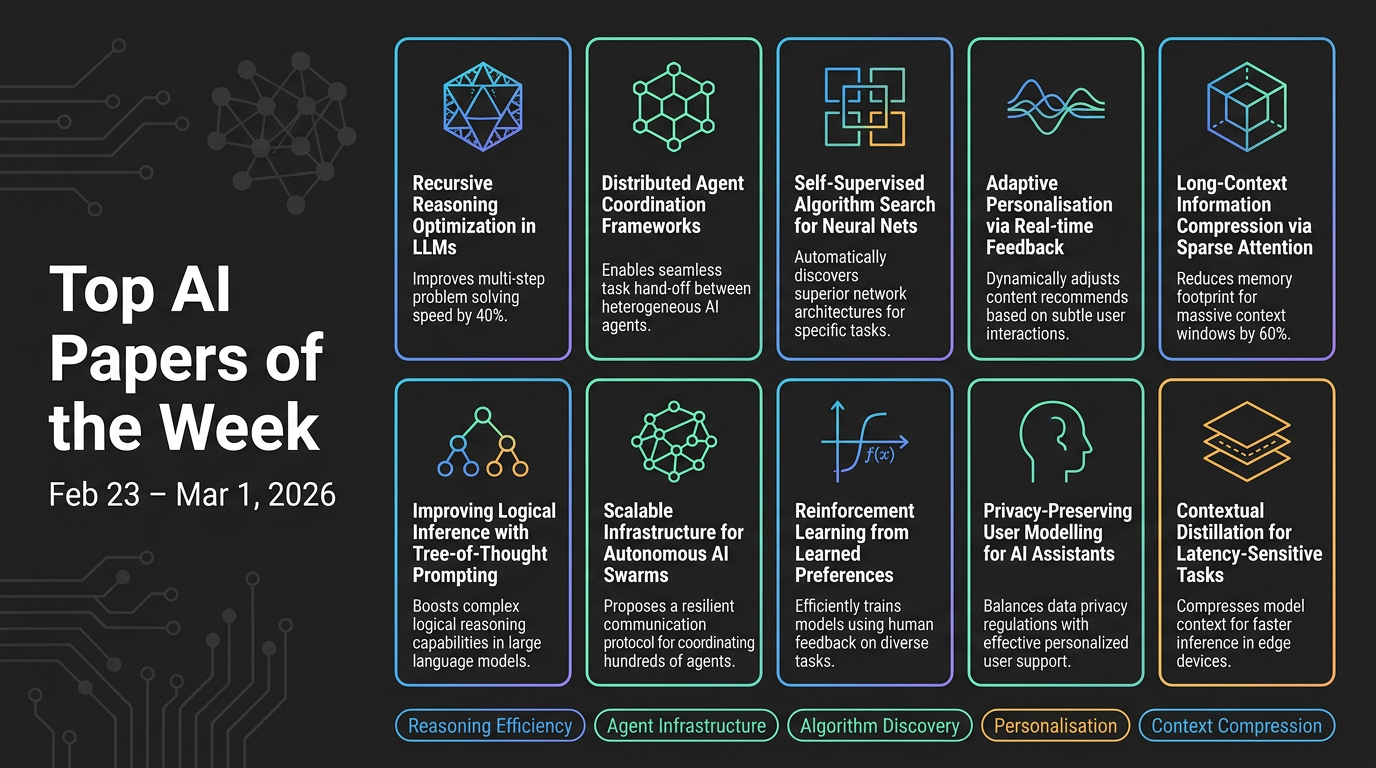
Top AI Papers of the Week (February 23 – March 1, 2026)
Elvis Saravia's weekly AI newsletter rounds up ten notable research papers spanning reasoning efficiency, agent infrastructure, algorithm discovery, personalization, context compression, and code generation. Here's a detailed breakdown:
1. Deep-Thinking Tokens
Google researchers argue that longer outputs don't equal better reasoning. They introduce deep-thinking tokens — tokens where internal model predictions shift significantly across layers before stabilising — measured via Jensen-Shannon divergence between intermediate and final layer distributions. A token qualifies as "deep-thinking" if its prediction only stabilises in the final 15% of layers.
- Raw token count negatively correlates with accuracy (r = -0.59), while the deep-thinking ratio shows a strong positive correlation (r = 0.683)
- Think@n: a test-time scaling strategy that prioritises high deep-thinking ratio samples, matching self-consistency performance while cutting inference costs ~50%
- Validated on AIME 24/25, HMMT 25, GPQA-diamond with GPT-OSS, DeepSeek-R1, Qwen3
- Takeaway: Focus on computational depth, not token volume
2. Codified Context
Single-file AGENTS.md manifests don't scale to large codebases. This paper presents a three-component infrastructure built during development of a 108,000-line C# distributed system, evaluated across 283 development sessions:
- Hot-memory constitution: A living document encoding conventions and orchestration protocols consulted at session start
- Domain-expert agents: 19 specialised agents, each owning a bounded codebase domain
- Cold-memory knowledge base: 34 on-demand specification documents retrieved only when needed
- Result: Prevents agents from forgetting conventions, repeating mistakes, and losing coherence across long-running projects
3. Discovering Multi-Agent Learning Algorithms with LLMs
Google DeepMind uses AlphaEvolve — an evolutionary coding agent powered by LLMs — to automatically discover new multi-agent learning algorithms for imperfect-information games.
- VAD-CFR: A novel iterative regret minimisation variant with volatility-sensitive discounting and consistency-enforced optimism — outperforms Discounted Predictive CFR+
- SHOR-PSRO: A population-based training variant blending Optimistic Regret Matching with temperature-controlled strategy distributions
- AlphaEvolve generates, evaluates, and iteratively refines algorithm candidates
- Takeaway: LLMs can act as algorithmic designers, not just code generators; approach could extend to optimisation, scheduling, and resource allocation
4. Evaluating AGENTS.md
A direct empirical evaluation of whether AGENTS.md files actually improve AI coding agent performance. Four agents tested: Claude Code (Sonnet-4.5), Codex (GPT-5.2 & GPT-5.1 mini), Qwen Code (Qwen3-30b-coder).
- Human-written AGENTS.md: modest +4% improvement in some cases
- LLM-generated AGENTS.md: -2% performance drop
- Both consistently increase inference cost by 20%+
- Context files cause broader exploration but worse outcomes — additional context introduces noise
- Takeaway: Keep AGENTS.md minimal and focused on critical constraints only; information density beats comprehensiveness
5. PAHF (Personalized Agents from Human Feedback)
Meta introduces PAHF, a continual agent personalisation framework coupling explicit per-user memory with proactive and reactive feedback mechanisms.
- Three-step loop: (1) pre-action clarification, (2) preference-grounded action, (3) post-action memory update
- Enables agents to accumulate and revise user preference profiles without retraining
- New benchmarks in embodied manipulation and online shopping measuring preference learning and adaptation to preference shifts
- Substantially faster learning and outperforms no-memory and single-channel baselines
6. Doc-to-LoRA
Sakana AI introduces Doc-to-LoRA (D2L), a lightweight hypernetwork that meta-learns to compress long documents into LoRA adapters in a single forward pass.
- Eliminates repeated expensive attention over long contexts; subsequent queries use only adapter weights
- Achieves near-perfect zero-shot accuracy on needle-in-a-haystack tasks at 4x beyond the target LLM's native context window
- Outperforms standard long-context approaches on QA datasets with less memory
- Best for: Applications requiring repeated queries over the same document (customer support, legal analysis, codebase understanding)
7. AgentConductor
AgentConductor is a RL-enhanced multi-agent code generation system that dynamically generates interaction topologies based on task complexity rather than using fixed communication patterns.
- LLM-based orchestrator constructs density-aware layered DAG topologies adapted to problem difficulty
- Simple problems → sparse topologies; complex problems → denser collaboration
- Results: Up to 14.6% improvement in pass@1 accuracy, 13% density reduction, 68% token cost reduction vs. strongest baseline
- Execution feedback refines topologies when initial solutions fail
8. ActionEngine
Georgia Tech and Microsoft Research introduce ActionEngine, a training-free framework transforming GUI agents from step-by-step executors into programmatic planners.
- Builds a state-machine memory through offline exploration
- Synthesises executable Python programs for task completion
- Achieves 95% success on Reddit tasks from WebArena
- Average of a single LLM call per task; 11.8x cost reduction, 2x latency reduction vs. vision-only baselines
9. CoT Faithfulness via REMUL
REMUL is a training approach making chain-of-thought reasoning more faithful and monitorable using a speaker-listener RL framework.
- A speaker model generates reasoning traces; multiple listener models attempt to follow and complete them
- RL rewards reasoning understandable to other models
- Tested on BIG-Bench Extra Hard, MuSR, ZebraLogicBench, FOLIO
- Improves three faithfulness metrics while boosting accuracy; produces shorter, more direct reasoning chains
10. Learning to Rewrite Tool Descriptions
Intuit AI Research introduces Trace-Free+, a curriculum learning framework that optimises tool descriptions for LLM agents (not humans) without relying on execution traces.
- Delivers consistent gains on unseen tools
- Strong cross-domain generalisation
- Robust as candidate tools scale beyond 100
- Takeaway: Improving tool interfaces is a practical complement to agent fine-tuning
Key Themes This Week
- Efficiency over verbosity: Deep-thinking tokens and AgentConductor both show that targeted computation beats brute-force scaling
- Context is a double-edged sword: AGENTS.md evaluation and Codified Context both highlight that more context isn't always better — structure and density matter
- LLMs as meta-designers: AlphaEvolve demonstrates LLMs discovering algorithms that humans hadn't considered
- Personalisation at scale: PAHF and Doc-to-LoRA both address how to make AI systems adapt to individual users and documents without prohibitive retraining costs