
OpenClaw Architecture Part 5: Tools, Plugins, and Capability Boundaries
Original article: OpenClaw Architecture - Part 5: Tools, Plugins, and Capability Boundaries
Processed: 2026-03-23
Summary
Main Thesis
When an AI agent gains the ability to call tools, the important question shifts from "what did the model say?" to "what will the system do on its behalf?" OpenClaw's architecture makes capability boundaries explicit and distinct from mere prompt guidance — real enforcement lives in tool policy, approvals, sandboxing, and channel controls, not in the model's self-description.
Key Argument
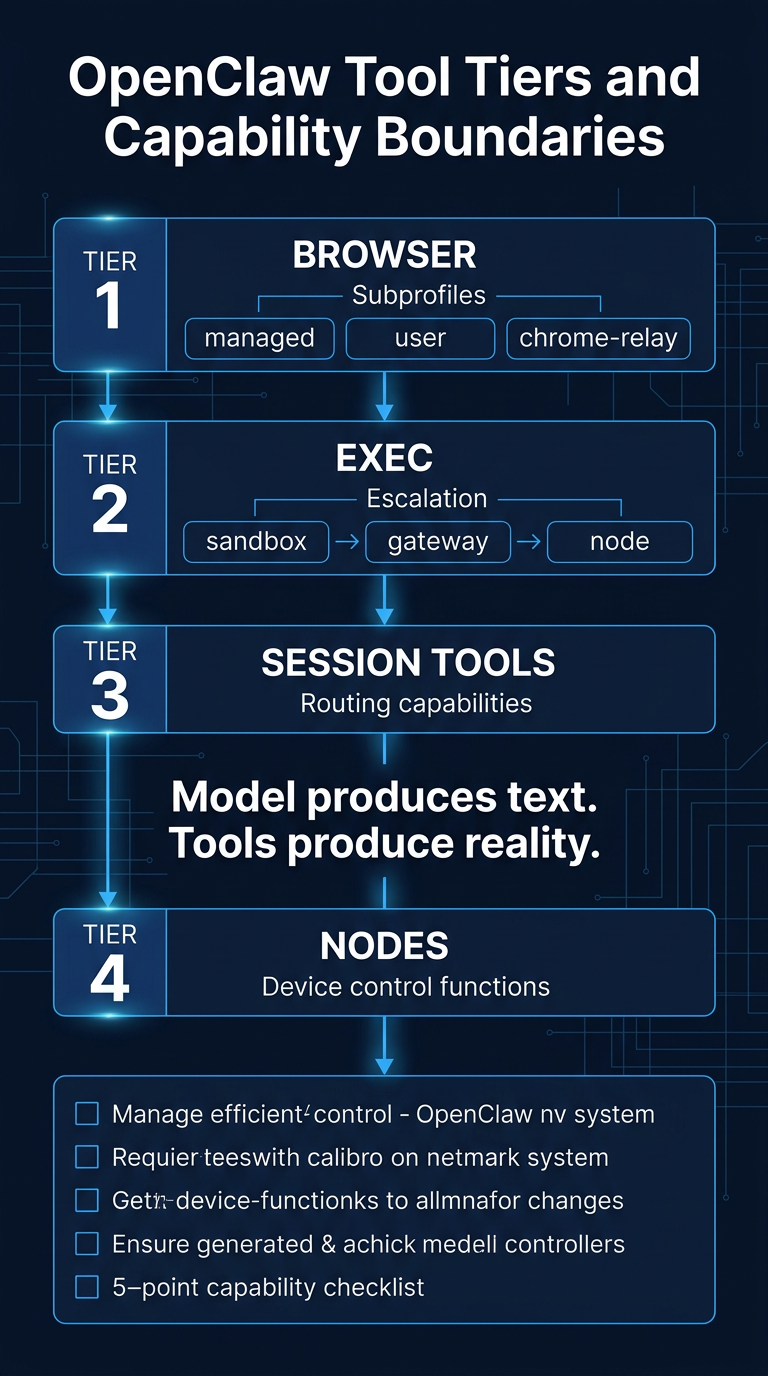
The author frames tools as where "chat stops being chat and starts becoming action." A model produces text; a tool produces reality. This distinction underpins the entire analysis of how OpenClaw structures its capability surface.
Key Findings
Tool Profiles & Policy
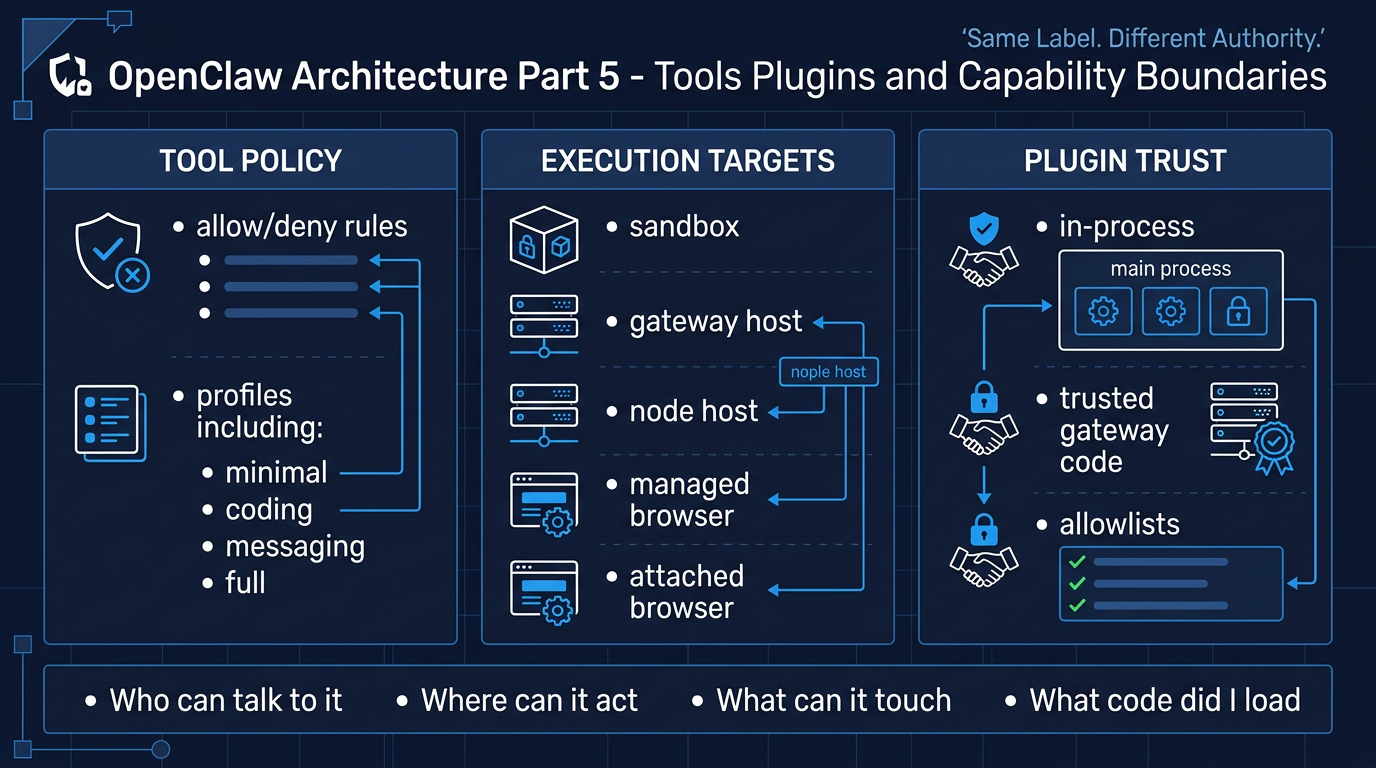
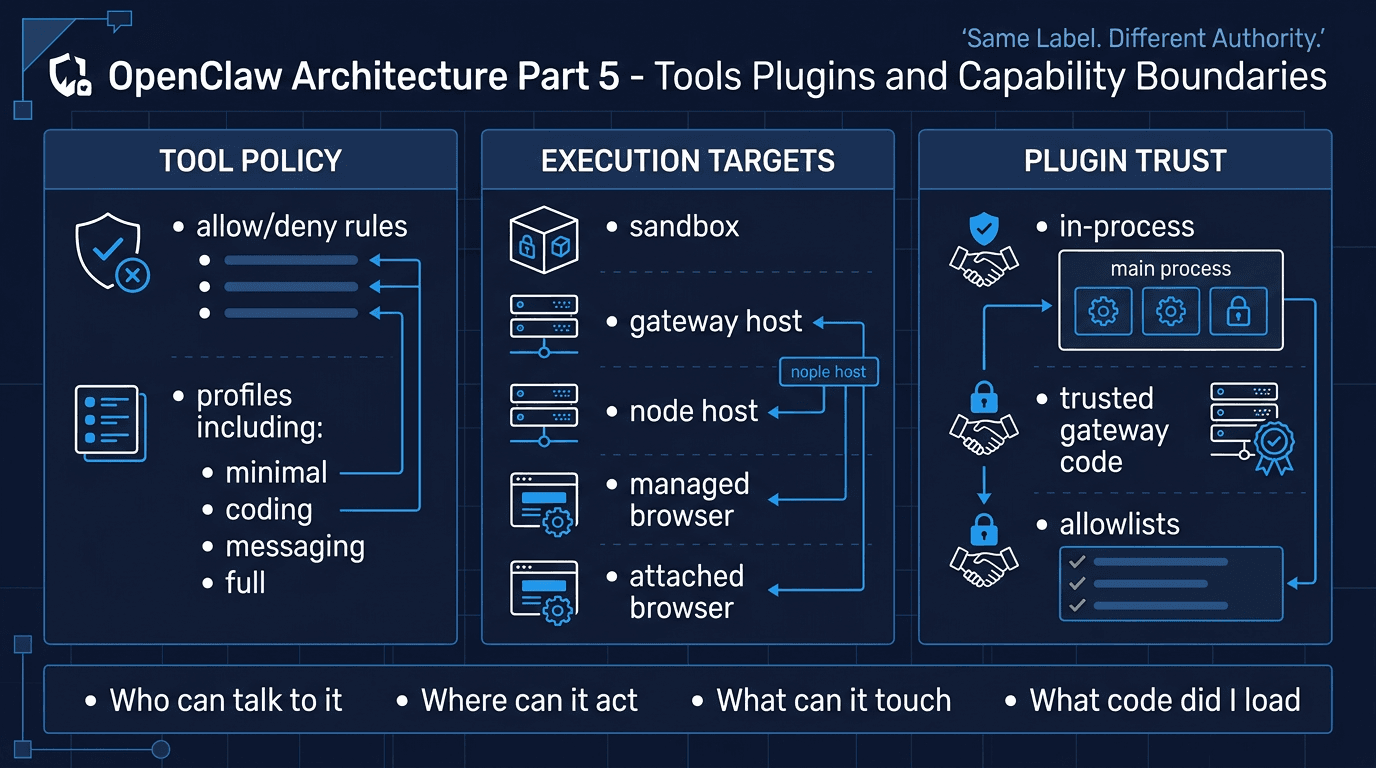
- OpenClaw provides named tool profiles: minimal, coding, messaging, and full
- Further scoping via tools.allow and tools.deny — deny always wins
- Disallowed tools are never sent to model providers at all
Capability Tiers (not a flat tool list)
- Browser: Three distinct profiles with different inherited state and authority — openclaw (isolated, managed), user (attaches to a real signed-in Chrome session), chrome-relay (extension relay mode). Same tool label, very different consequences.
- Exec: host=sandbox, host=gateway, host=node are different execution targets with escalating blast radius — not implementation details.
- Session Tools: sessions_list, sessions_history, sessions_send, sessions_spawn are routing power. Session visibility scope is configurable: self, tree, agent, or all.
- Nodes: Companion devices expose command families (canvas., camera., device., notifications., system.*) — extending the same agent loop to physical hardware.
Session Ownership vs Authorization
- A sessionKey is for routing and context isolation — not per-user authorization
- If multiple people steer one tool-enabled agent, they share one permission surface regardless of session isolation
- Memory isolation helps with privacy, not with authorization
Plugins = Trusted Gateway Code
- Plugins run in-process with the Gateway — not sandboxed
- They can register tools, hooks, HTTP routes, Gateway methods, commands, services, context engines, skills, auto-reply commands
- Installation and enablement are trust-sensitive operations
- plugins.allow is useful, but id-based trust is not the same as provenance-based trust
Approvals as Interlocks, Not Absolution
- Approvals slow down real-world actions at the edge where it matters
- They do not turn a broad capability surface into a narrow one
Practical Takeaways
- Start with the smallest tool profile that still works for your use case
- Treat sessionKey and Memory isolation as routing and privacy boundaries — not authorization
- Choose execution targets explicitly: managed browser vs. attached browser, sandbox vs. gateway host vs. node host
- Keep broad control surfaces off untrusted inputs unless you really mean it
- Treat plugins and skills as trusted Gateway code — not optional add-ons
- Use approvals as interlocks, not substitutes for scoping
- Put lifecycle events, hooks, and logs around capability use for auditability
The Four Boundary Questions
The author proposes a simple audit framework:
- Who can talk to it? pairing, allowlists, group policy, shared tool surfaces
- Where can it act? browser profile, execution host, node availability
- What can it touch? tool profiles, deny rules, session visibility, node permissions
- What code did I load? plugins, skills, route handlers, command handlers
This replaces generic checklists with architecture-mapped questions that reflect actual enforcement points.
Context in the Series
This is Part 5 of a multi-part OpenClaw architecture series. Part 1 covered why the agent feels "alive" (more inputs, durable state, loop). Part 5 is where the loop becomes consequential via tools. Part 6 (upcoming) covers observability, recovery, evaluation, and containment.
Infographics