
Executive Briefing: One solo founder just sold for $80M in 6 months. Your 50-person department is building the same thing for Q3. + the framework that explains why
Original article on Nate's Substack
Processed: 2026-03-16
Summary
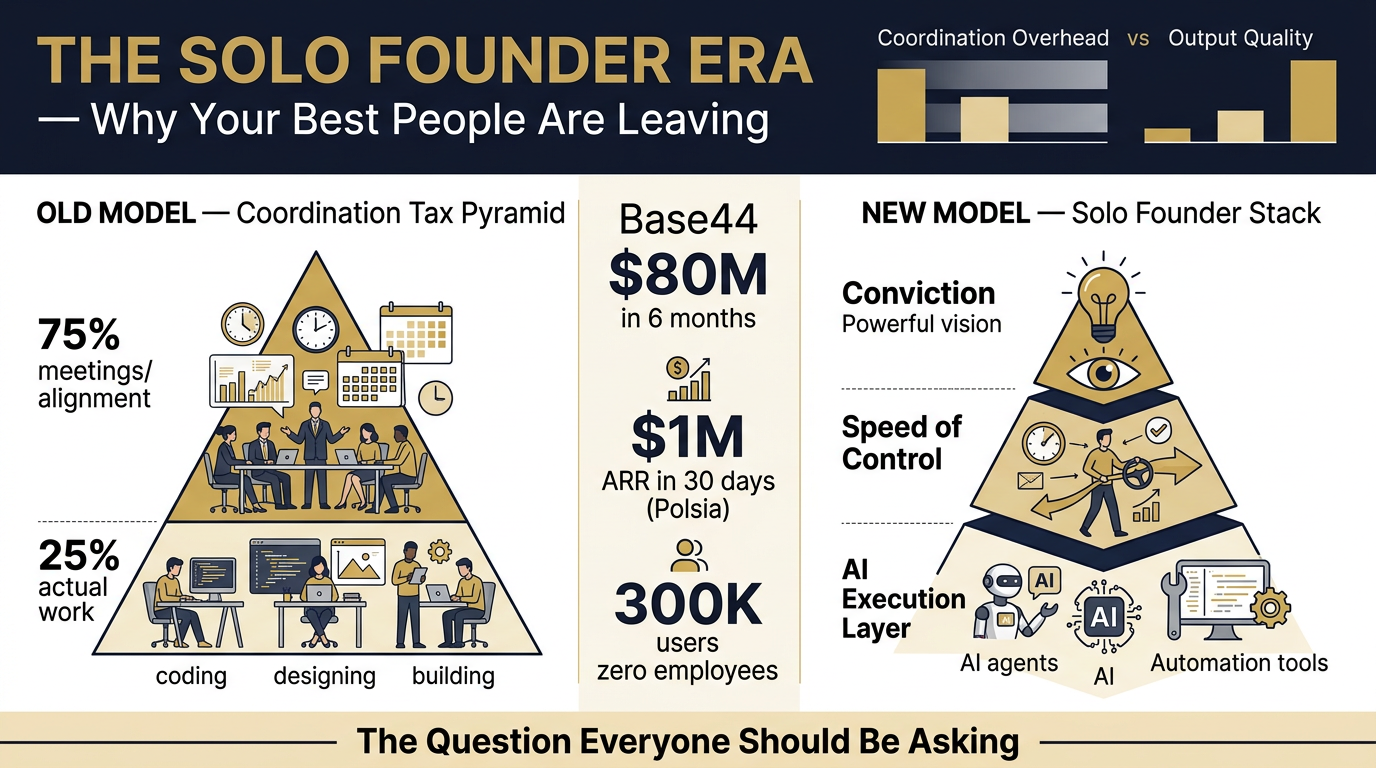
A senior product manager with six years of experience left her job, picked up Claude Code and Cursor, and in one month shipped a working product with paying customers — one her former employer had been roadmapping for Q3. This story is repeating everywhere. Nate's thesis: the solo founder explosion isn't about new capabilities emerging. It's about an old capability — conviction — being uncapped.
Main Thesis
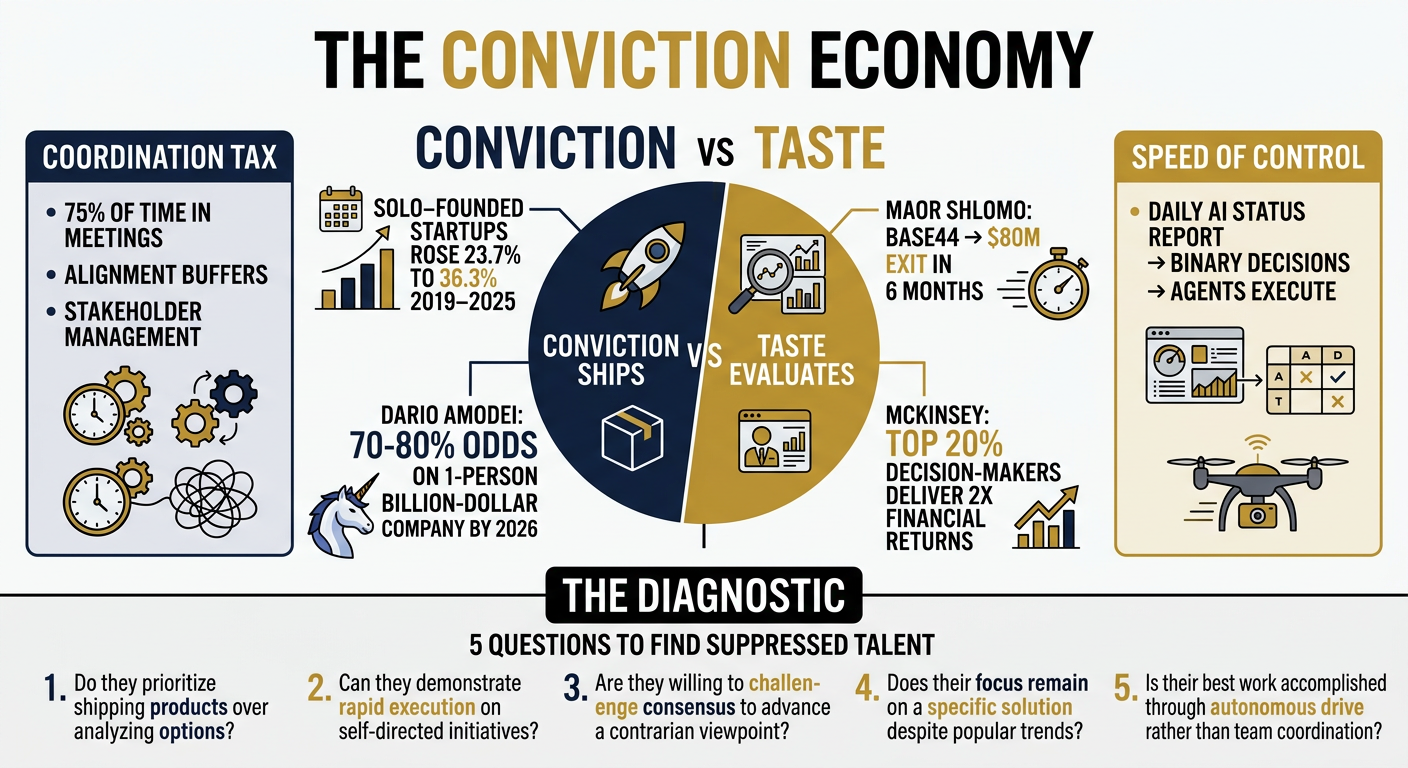
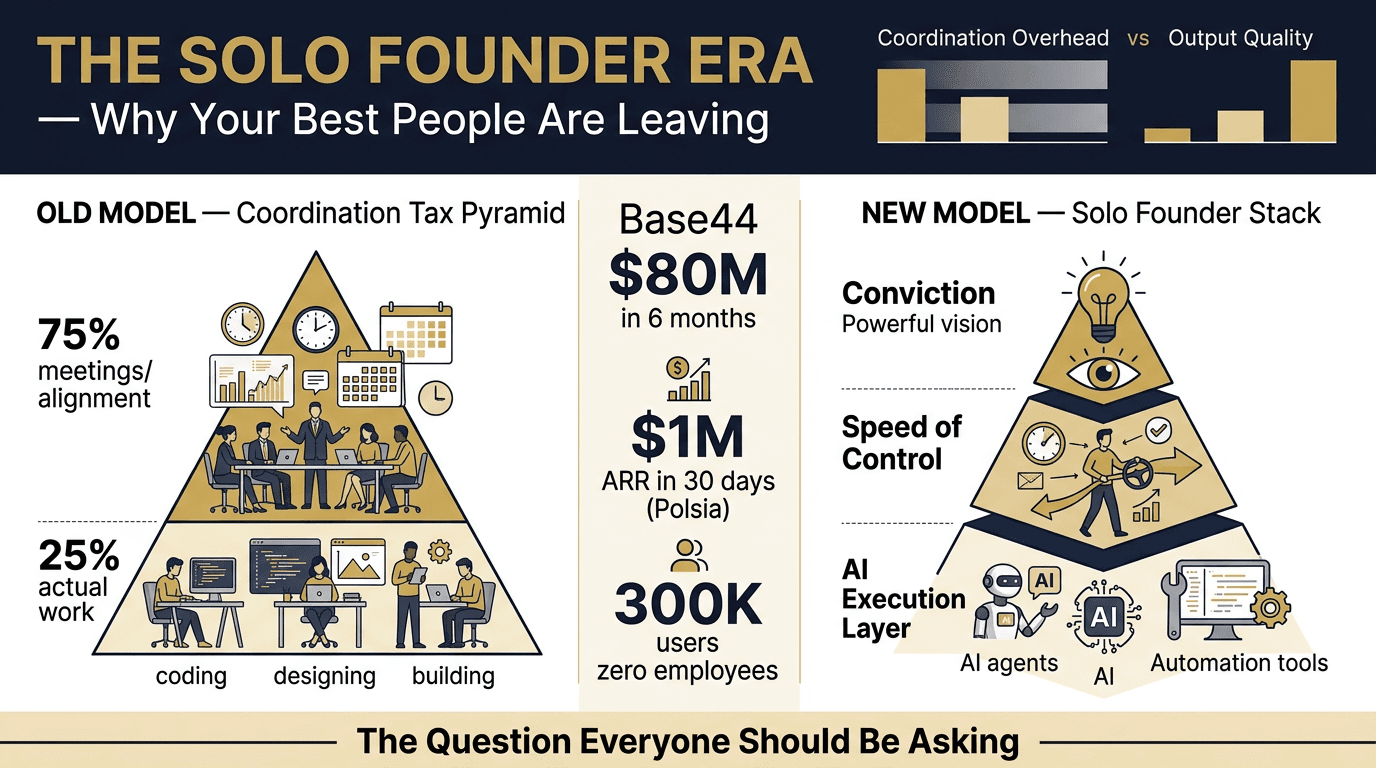
Organizations don't lack extraordinary people. They suppress them. The coordination tax — 75% of working hours spent in alignment meetings, stakeholder management, and cross-functional syncs — has been the invisible ceiling on talent output for decades. AI has removed the execution barrier, exposing the coordination overhead for what it always was: a structural tax on conviction.
The question everyone asks: "How do we find extraordinary people?"
The question they should ask: "How did we build organizations that make extraordinary people look ordinary — and now that AI lets those people route around us entirely, what's our plan?"
Key Data Points
- Maor Shlomo built Base44 to 300,000 users, sold to Wix for $80M cash in 6 months
- Ben Broca crossed $1M ARR with Polsia in his first month, zero employees
- Pieter Levels runs $3M+ ARR portfolio as a solo operator
- Sarah Gwilliam, a grief coach with no technical background, launched Solace — an AI grief platform — through an AI-native incubator with no co-founder
- Carta data: Solo-founded startups rose from 23.7% → 36.3% of all new US ventures (2019 to mid-2025)
- Dario Amodei: 70–80% odds on a one-person billion-dollar company by 2026
- McKinsey: Top 20% of decision-makers are nearly 2x as likely to deliver 20%+ financial returns; employees are 3.2x more likely to be empowered to decide rather than escalate
- METR RCT: Experienced developers were 19% slower with AI tools but believed they were 20% faster — a 39-point perception gap
Conviction vs Taste
The viral framing is "80% AI, 20% taste." Nate argues it's pointing at the wrong 20%. Taste evaluates. Conviction ships. Conviction is acting on your vision before anyone agrees it's right. It's not just confidence — it's taste-backed pattern recognition earned through decades of reps. Ben Broca's conviction is backed by 15 years in engineering, product, management, and operations. Pieter Levels calibrated his through 40+ shipped projects, mostly failures.
Speed of Control (Not Span of Control)
The bottleneck in AI-era output isn't how many things you oversee — it's how fast you can cycle through high-quality decisions. Ben Broca's AI CEO agent emails him a daily status report. He makes rapid binary judgment calls. Agents execute until the next decision point. The key skill: prioritization at speed — scanning broadly, instantly recognizing where your judgment adds the most value.
Three Theses
- Extraordinary people were never blocked by ability — only overhead. Give them the right tools and a long weekend and they ship what their team couldn't in a quarter.
- AI is compressing the learning curve itself. The gap between junior and senior is narrowing faster than anyone expected.
- Your organization's compromise tax is about to be exposed. Every layer of consensus required before action is now a competitive liability.
The Variable Everyone Gets Wrong
It's not volume — it's correctness. When AI handles execution at near-zero marginal cost, the bottleneck is decision quality, not decision speed alone. The senior developer paradox (shipping 2.5x more AI code but spending so much time reviewing it offsets the gains) proves the old instincts don't automatically translate.
Practical Takeaways
- Run a Coordination Tax Audit — quantify how much of your best people's time goes to translation and alignment, not actual work
- Design Scout Missions — real problems, real people, with evaluation rubrics based on judgment density and conviction velocity (not hackathon theatre)
- Redesign your talent assessment — your current promotion criteria probably rewards coordination skill over decision quality
- Map your decision architecture — identify where approvals are creating a conviction tax
Prompt Kit
Prompt Kit: The Talent Was Always There
This kit operationalizes the core framework — speed of control, coordination tax, and conviction-driven talent — into four executive-grade prompts.
How to use: Run in a thinking-capable model (ChatGPT, Claude, Gemini). Be candid — output quality scales with your honesty about how your org actually operates.
Prompt 1: Coordination Tax Audit Quantifies exactly how much extraordinary talent your organization is suppressing through coordination overhead, and identifies where that overhead can be cut first. Get: A detailed breakdown of the coordination tax across your org — where time goes, which decision chains are bottlenecks, which roles are most capped, and a prioritized list of overhead to eliminate ranked by talent-liberation potential.
Prompt 2: Scout Mission Designer Designs a concrete scout mission — a real problem, assigned to a real person, with a clear evaluation rubric — that tests uncapped potential against the speed of control framework. Get: A complete mission brief you can hand to someone this week, including problem, constraints, success criteria, and an evaluation rubric measuring judgment density, conviction velocity, and execution bandwidth.
Prompt 3: Speed of Control Talent Assessment Redesign Redesigns your talent evaluation system — performance criteria, promotion rubrics, hiring screens, and review processes — around the speed of control framework instead of coordination skills. Get: A replacement evaluation framework with specific, observable criteria for judgment density, conviction velocity, and execution bandwidth, plus transition guidance.
Prompt 4: Conviction-Driven Operating Model Roadmap Produces a phased strategic plan for restructuring your organization from consensus-driven to conviction-driven. Get: A concrete restructuring roadmap with phases, decision-rights reassignment, specific processes to eliminate, AI deployment priorities, retention plays for your highest-judgment people, and a realistic assessment of what you'll break along the way.
Infographics