
Executive Briefing: 33% of the world's helium supply just went offline. Your AI infrastructure plan doesn't account for it.
Updated
•2 min read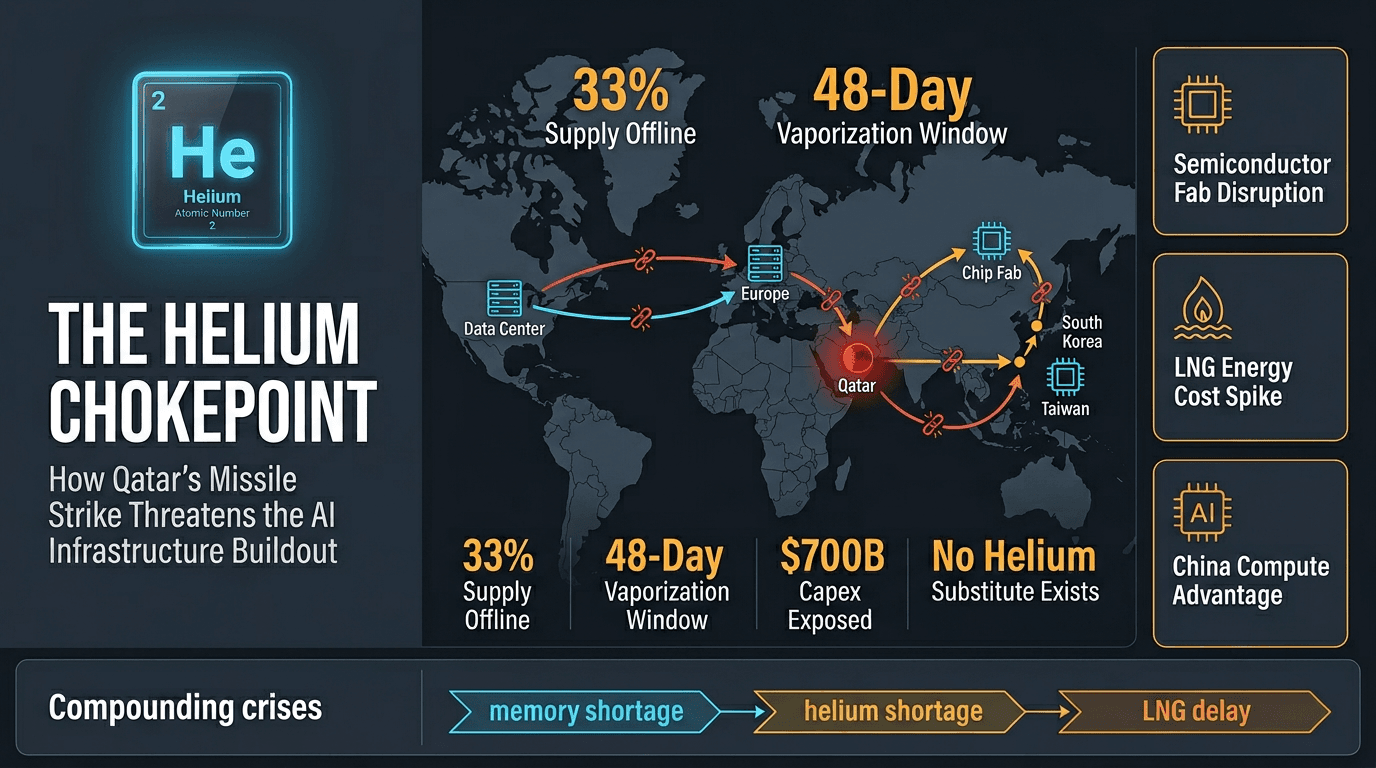
Executive Briefing: 33% of the World's Helium Supply Just Went Offline
Main Thesis
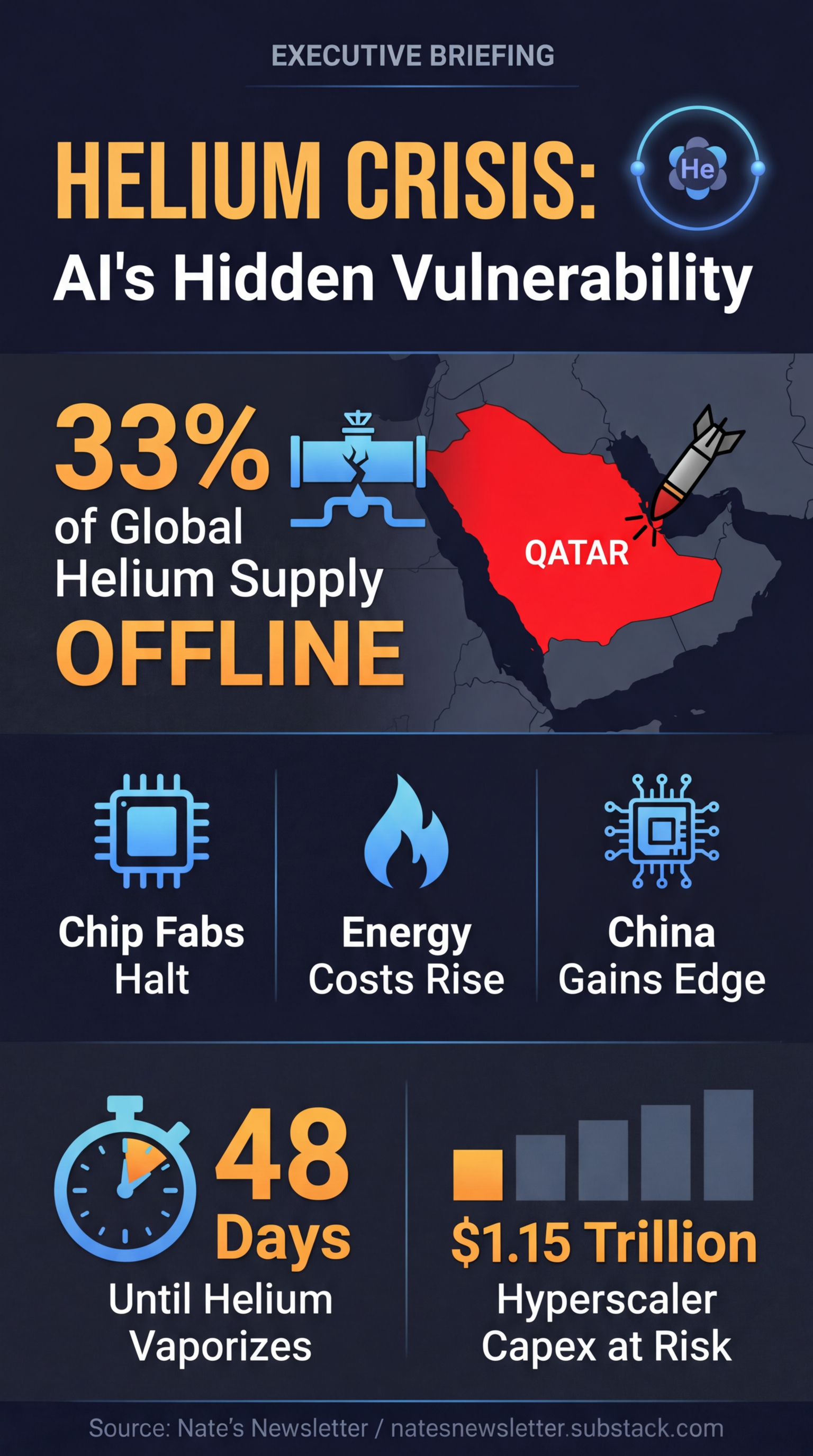
A missile strike on Qatar's helium production complex has taken roughly one-third of the global helium supply offline, creating a critical — and largely unacknowledged — vulnerability in the AI infrastructure buildout. The $600–700 billion in AI capex committed by the five largest US cloud providers this year depends on semiconductor fabs that cannot operate without helium, and there is no substitute.
Key Findings
The Helium Crisis
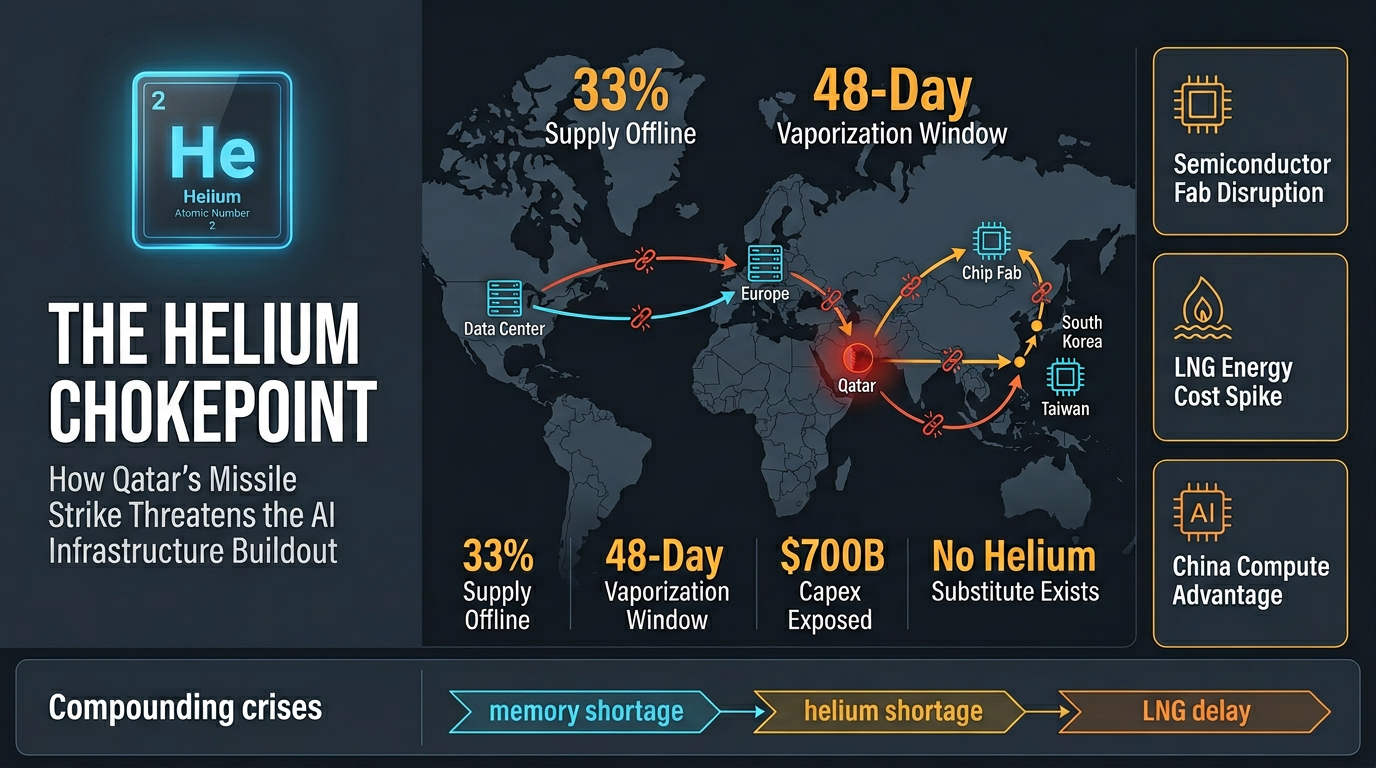
- Qatar's industrial complex (responsible for ~33% of world helium supply) was struck by Iranian missiles and is offline, with parts destroyed
- The shipping strait through which helium exports travel is closed
- Liquid helium containers vaporize their contents within 48 days — the clock is already running
- Helium is essential for chip fabs: lithography machines, wafer cooling, and vacuum leak detection — no substitutes exist
Three Channels of Impact
- Helium Supply — Direct hit to GPU chip production in South Korean and Taiwanese fabs
- LNG Energy Costs — Qatar is also a major LNG supplier; the disruption raises energy costs for data centers globally
- Geopolitical Restructuring — Russia-to-China pipeline gas could structurally advantage Chinese semiconductor manufacturing over US-allied fabs for the next decade
Compounding Factors
- The helium disruption lands into an already severe memory shortage in the semiconductor supply chain, amplifying the impact
- Goldman Sachs projects $1.15 trillion in hyperscaler capex from 2025–2027 — all of it assumes chips arrive on schedule
- The LNG expansion meant to make energy cheap by 2028 is now delayed
Geopolitical Angle
- Countries that fabricate chips are not the same countries that run data centers
- Russian pipeline gas flowing to China creates an energy cost asymmetry that favors Chinese compute economics over the next decade
Practical Takeaways
- AI infrastructure plans need physical supply chain audits — noble gas dependencies are real and unpriced
- Executives should pressure-test chip delivery timelines against helium availability
- Energy cost assumptions for AI data centers need revision given LNG disruption
- The geopolitical restructuring may require reassessment of where AI manufacturing capacity is built and sourced
- The article presents five counterarguments to its thesis (detail behind paywall), suggesting a balanced but urgent risk framing
Bottom Line
The AI arms race is treating a deeply physical, resource-constrained supply chain as if it were infinitely scalable software. Qatar's helium shutdown is a stress test that exposes how fragile the entire $1+ trillion buildout really is.