Executive Briefing: 33% of the world's helium supply just went offline. Your AI infrastructure plan doesn't account for it.
Updated
•2 min read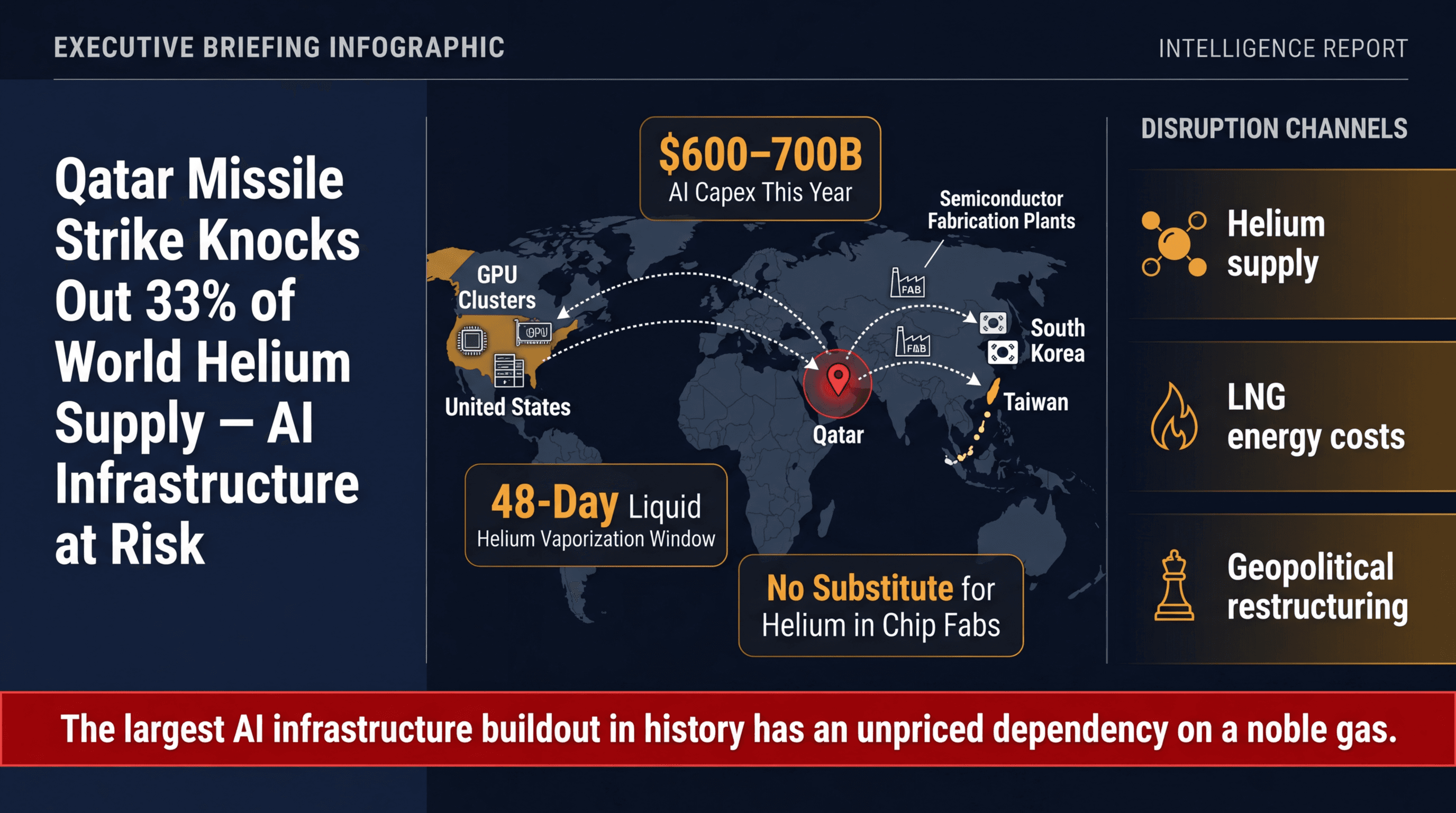
Executive Briefing: 33% of the World's Helium Supply Just Went Offline
Main Thesis
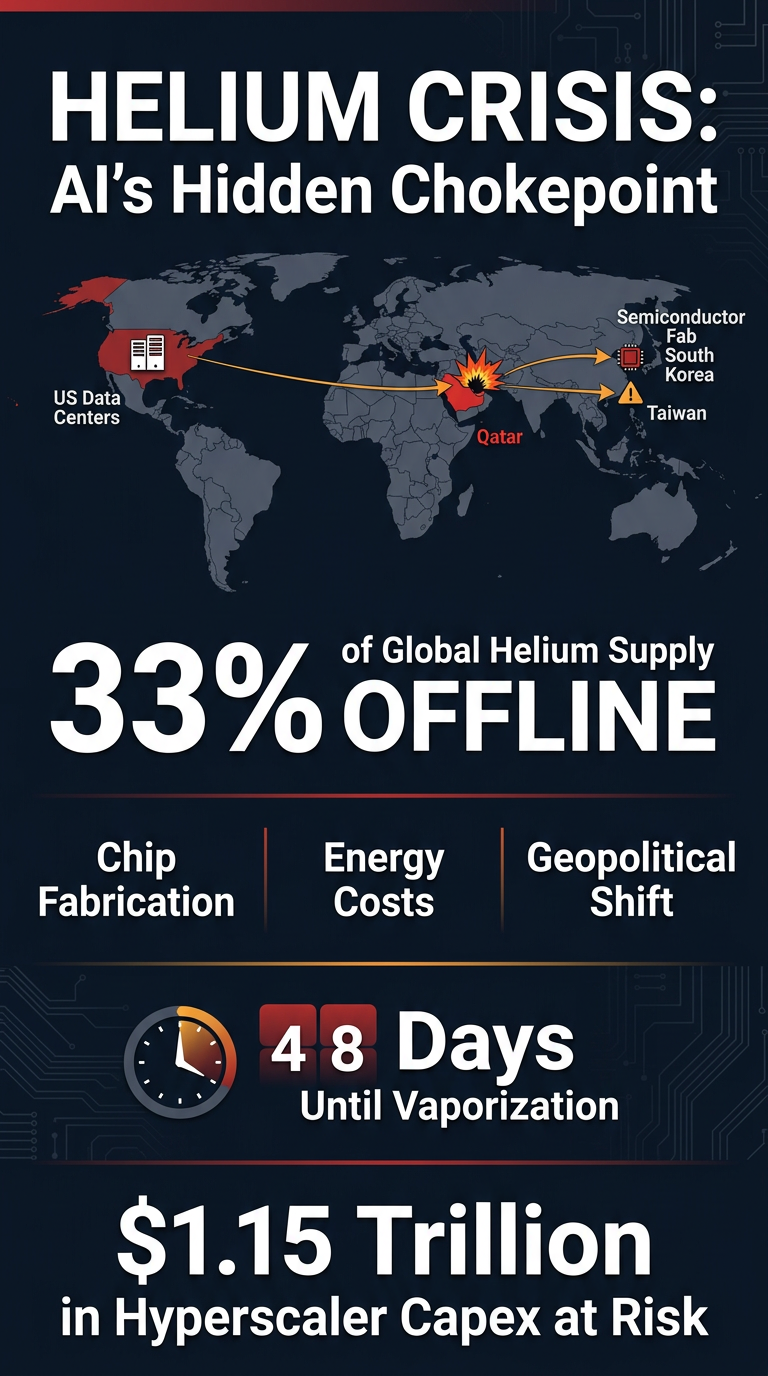
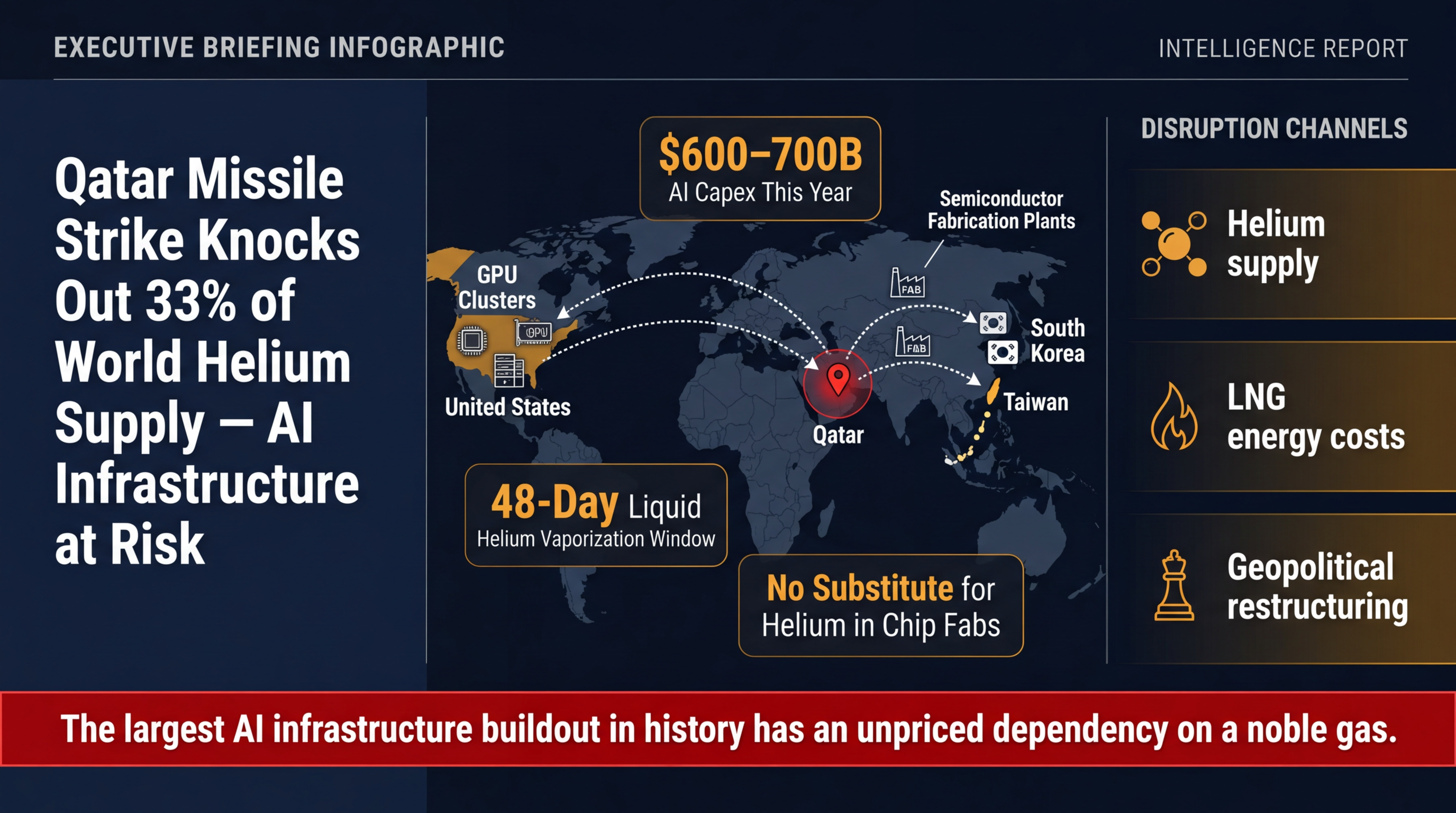
A missile strike on Qatar's helium production complex has taken offline approximately one-third of the global helium supply, exposing a critical and largely unacknowledged dependency at the heart of the AI infrastructure boom. The $600–700 billion in AI capex committed by major US cloud providers in 2026 alone assumes chip supply chains will function normally — and they won't without helium.
Key Findings
The Helium Crisis
- Qatar hosted a single industrial complex supplying ~33% of the world's helium
- Iranian missiles struck the facility ~3 weeks ago; it is partially destroyed and offline
- The shipping strait for its output is closed
- Liquid helium containers vaporize their contents within 48 days — the clock is running
- There is no substitute for helium in semiconductor fab processes: lithography machines, wafer cooling, and vacuum leak detection all require it
Three Channels of Impact
- Helium Supply Disruption — Semiconductor fabs in South Korea and Taiwan face direct input shortages, threatening GPU and chip production timelines
- LNG Energy Costs — The same geopolitical disruption affects liquefied natural gas pricing, raising energy costs for data centers
- Geopolitical Restructuring — Russia-to-China pipeline gas may structurally advantage Chinese semiconductor manufacturing over the US-allied fab ecosystem for the next decade
Compounding Factors
- The disruption hits during the most severe memory shortage in industry history, amplifying supply chain stress
- The LNG expansion expected to cheapen energy by 2028 is now delayed
- Countries that fabricate chips (South Korea, Taiwan) are not the same countries that run data centers (US), creating an energy asymmetry
The Scale of What's at Risk
- Google's co-founders reportedly said they'd rather go bankrupt than lose the AI race
- Goldman Sachs projects hyperscaler capex at $1.15 trillion from 2025–2027
- 75% of current capex is AI infrastructure — all of it dependent on chip delivery schedules
Practical Takeaways
- AI infrastructure plans must account for physical substrate dependencies — helium, rare gases, and energy inputs are not abstracted away by software
- Procurement and supply chain teams should audit helium exposure across their semiconductor vendors immediately
- Geopolitical risk modelling for AI buildouts needs to include Gulf region instability and its knock-on effects on Asian fabs
- Chinese compute economics may gain a structural advantage if Russia-China gas pipelines reduce their energy costs while Western fab inputs remain disrupted
- The 48-day vaporization window on liquid helium containers means the shortage impact will be felt within weeks, not months