
AI cut execution cost by 10x. The companies cutting headcount are making the most expensive mistake of 2026 + 4 prompts to build the alternative
Original article: Nate's Substack — March 15, 2026
Processed: March 15, 2026
Summary
Main Thesis
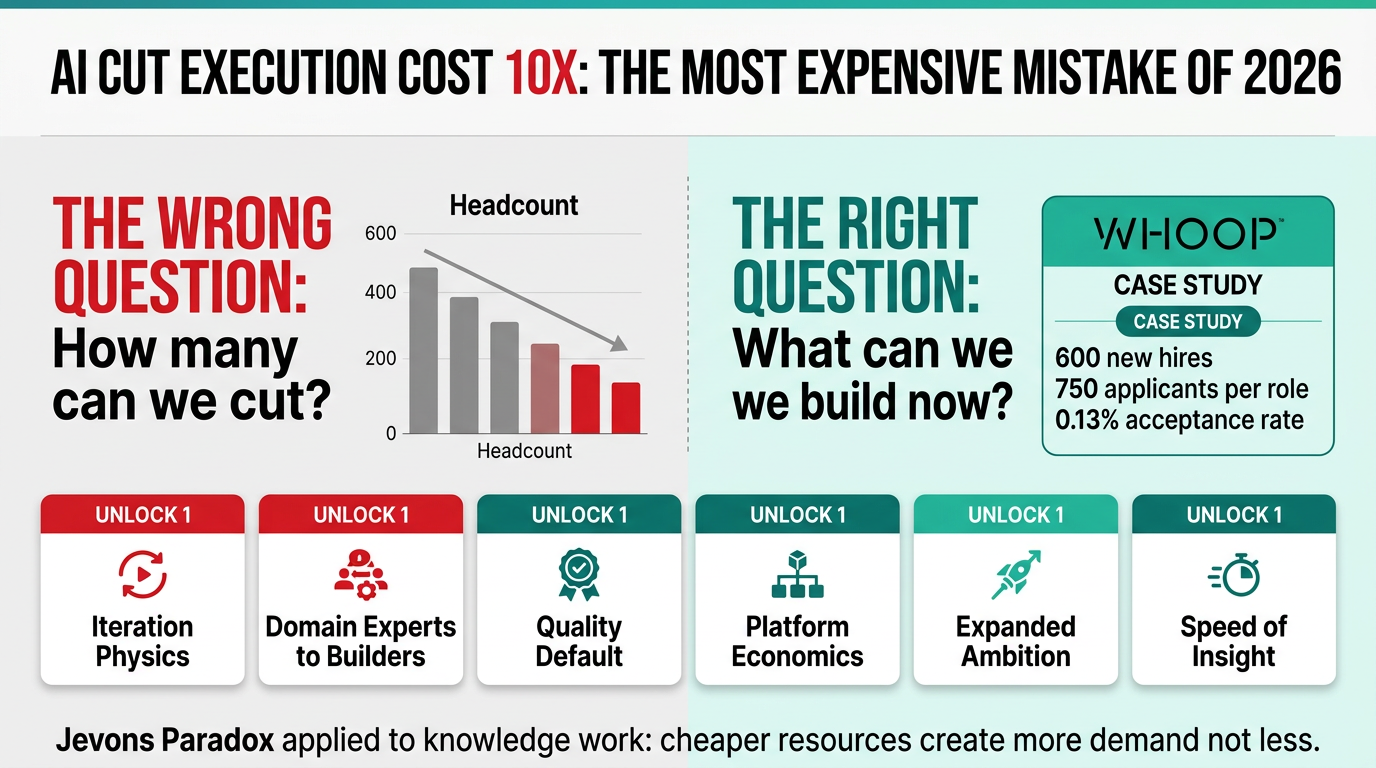
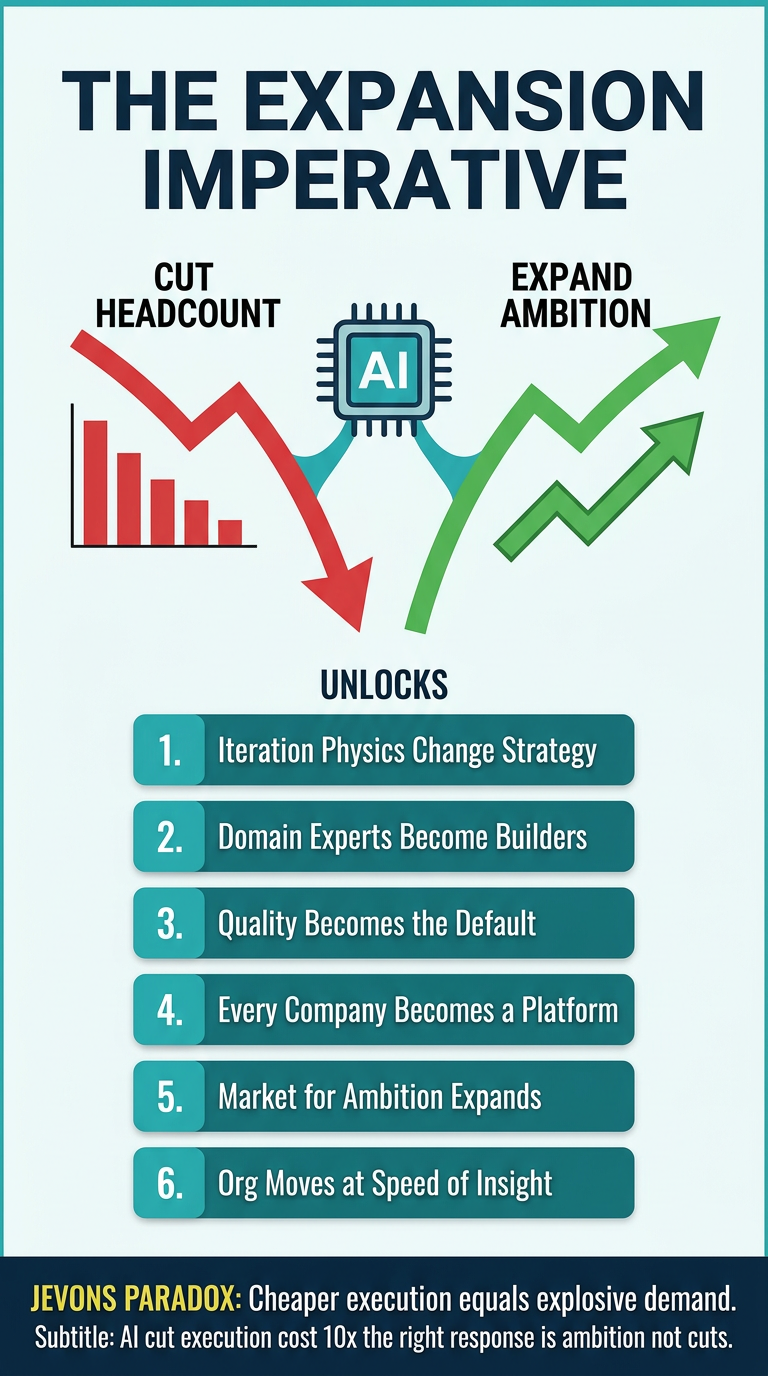
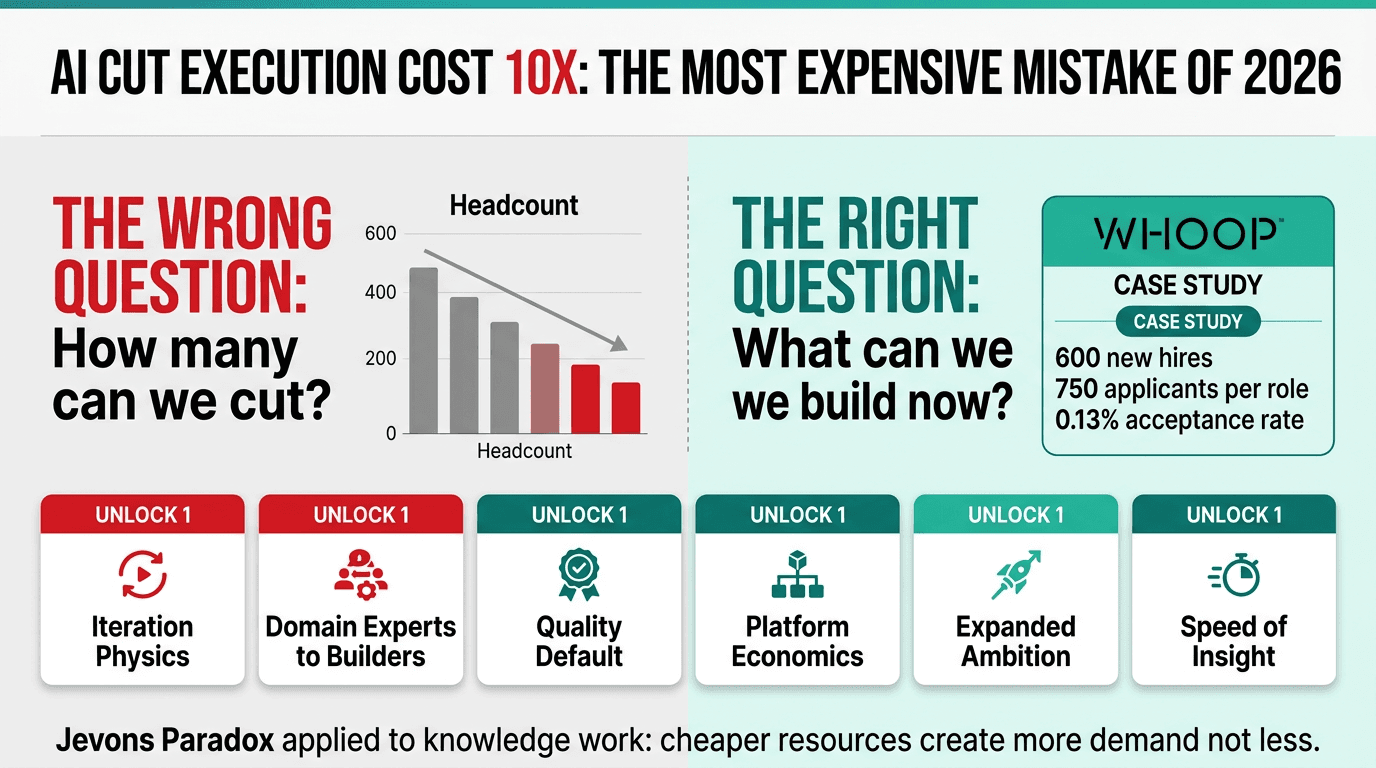
This is Part 3 of Nate's series on AI and the future of work. The central argument: cutting headcount because AI made your team more productive is the wrong response to the right observation. When AI collapses execution cost by an order of magnitude, the correct move isn't to do the same work with fewer people — it's to pursue dramatically more work. Companies that pocket the savings will have beautiful margins and no growth; companies that bet on expansion will be unrecognizable in three years.
The Whoop case study anchors the argument: CEO Will Ahmed announced 600+ new hires (nearly doubling its 800-person workforce) at a 0.13% acceptance rate, explicitly because AI expands what's possible, not because it makes people redundant.
Key Data Points & Findings
- Jevons Paradox applied to knowledge work: When a resource gets cheaper, total consumption rises — not falls. AI-driven efficiency in knowledge work should expand total demand for insight, judgment, creativity, and domain expertise, not contract it.
- Whoop: 600 new hires at 750 applicants per position (0.13% acceptance rate). CEO is betting on expansion, not contraction.
- Cursor's cloud agents (Feb 2026): Developers can run 10–20 parallel agents on isolated cloud VMs simultaneously. ~35% of Cursor's own merged pull requests are now created by autonomous agents.
- Developer universe vs. domain expert universe: ~36–47 million software developers globally vs. hundreds of millions of domain experts who know what software should exist but can't build it.
- Shopify's AI rollout: Finance, sales, and support teams — not engineers — were the fastest-growing adopters of Cursor licenses. 1,500 licenses were snapped up immediately, leading to an order for 1,500 more.
- Iteration physics change: Learning cycles compress from quarters to days; companies can run 200 learning cycles/year instead of 8. The cost of a failed experiment drops from "a quarter of roadmap capacity" to "a day of agent compute."
Six Unlocks (The Expansion Opportunity Set)
- Iteration changes the physics of strategy — When cycles compress to days, exploration becomes the default instead of a luxury. Self-censorship of "too risky" ideas evaporates when testing is cheap.
- Domain experts become builders — Doctors, teachers, logistics managers, financial advisors who know exactly what software should exist can now build it directly. The translation gap (domain knowledge → software) collapses. This shift is described as "civilizational" — moving from 36 million builders to hundreds of millions.
- Quality becomes the default, not the premium — Testing, documentation, security review, accessibility audits become standard default steps rather than expensive add-ons. The gap between the top 5% of engineering teams and everyone else narrows dramatically.
- Every company becomes a platform — Custom integrations become achievable overnight instead of sitting in backlogs. Walled-garden moats weaken; competition shifts to product quality.
- The market for ambition expands — Opportunities previously "too small to staff" ($10M markets, 20%-chance R&D bets, geographic expansions) flip to profitable when execution cost drops 10x. Jevons Paradox at scale.
- Organizations move at the speed of insight — The lag from "someone sees a problem" to "org acts on it" collapses from months to hours. The person with the insight can test a working prototype by end of day instead of writing a brief that goes through 6 organizational layers.
The Real Reframe
The imagination failure — not the technology — is the expensive mistake. The entire public conversation has collapsed into "who gets replaced?" drowning out the far more consequential question: "what becomes possible?" The six unlocks described are the obvious ones; the applications that will define the next decade are the ones that can't be seen yet from inside the old doom frame.
The article also acknowledges the displacement reality (40–60% of current headcount performs work that is already automatable or will be in 18 months) but argues the fixed-pie framing is empirically wrong. The pie was artificially constrained by execution cost.
Practical Takeaways
- Stop starting AI strategy conversations from "how many can we cut?" — start from "what can we build that was previously impossible?"
- Run the Ambition Audit before your next strategy session to surface self-censored opportunities
- Identify domain experts in your org (non-engineers) who know what software should exist and connect them with AI coding tools
- Redesign your insight-to-action workflows so the person who sees the problem can test a solution the same day
- The hardest work ahead is figuring out what upskilling looks like when the job isn't "do the same thing faster" but "do something you've never been asked to do before"
Prompt Kit
From Grab the prompts — The Ambition Unlock Prompt Kit
This kit turns the article's core argument — that collapsing execution cost demands expansion, not contraction — into four working prompts. Each one forces a specific strategic conversation: surfacing the opportunities your org has been self-censoring, turning domain expertise into buildable specs, making the economic case for expansion over cuts, and compressing the gap between insight and action.
How to use this kit
These prompts are designed for leaders, operators, and domain experts who are ready to stop asking "how many people can we cut?" and start asking "what can we build now that was previously impossible?" Run them in any capable AI assistant — ChatGPT, Claude, or Gemini all work well.
- Prompt 1 (Ambition Audit) is the starting point for any leadership team. Run it before your next strategy session.
- Prompt 2 (Domain Expert → Builder) is for the non-engineers in your org who know what software should exist but have never been able to build it.
- Prompt 3 (Expansion Economics Brief) builds the board-ready case for investing in growth instead of pocketing the savings.
- Prompt 4 (Insight-to-Action Compression) is for operators who want to redesign specific workflows so the org moves at the speed of insight.
You can run them independently or in sequence. If you run 1 first, the opportunities it surfaces will feed directly into 3 and 4.
Prompt 1: The Ambition Audit
Job: Surface every opportunity your company has been self-censoring because execution cost made them "not worth proposing" — then rank them by potential impact.
When to use: Before strategic planning, board meetings, or any conversation where headcount and AI investment are on the table. Especially useful when your leadership team is defaulting to the cost-reduction frame.
What you'll get: A structured inventory of suppressed opportunities across your business — the ideas that never got proposed because they were too niche, too speculative, or too expensive to staff — ranked by a new viability score based on collapsed execution costs.
What the AI will ask you: Your company, industry, current team size, what your team spends most of its time on, the types of ideas that typically get killed in prioritization, and any markets or capabilities you've considered but shelved.
Prompt 2: Domain Expert → Builder Roadmap
Job: Help a non-engineer with deep domain expertise identify what they can now build with AI tools — and produce a concrete spec for their highest-impact project.
When to use: When you're a domain expert (healthcare, education, logistics, finance, legal, operations, etc.) who has always known what software should exist for your field but couldn't build it. Also useful for leaders trying to unlock builder capacity across non-engineering teams.
What you'll get: A prioritized list of tools you could build based on your domain knowledge, plus a detailed specification for the #1 project — written clearly enough that you could hand it to an AI coding tool and start building the same day.
What the AI will ask you: Your domain, your daily workflows, the problems you solve manually that should be software, and the workarounds you've built with spreadsheets, sticky notes, or willpower.
Prompt 3: The Expansion Economics Brief
Job: Build a rigorous, board-ready argument for why your company should invest in expansion — not headcount reduction — in response to AI-driven execution cost collapse.
When to use: When you need to persuade a board, executive team, or investors that the Whoop model (hire more + invest in AI) beats the "lean and mean" model. When the default conversation in your org is about cuts and you need to shift it to growth.
What you'll get: A structured strategic brief with the economic logic, historical parallels, specific opportunity sizing, and a concrete investment plan — written in the language that boards and C-suites actually respond to.
What the AI will ask you: Your company's financials (roughly), industry, current AI investments, what the "cut" camp is proposing, and what expansion opportunities you see but can't yet articulate in economic terms.
Prompt 4: Insight-to-Action Compression Map
Job: Identify the specific workflows in your organization where the lag between "someone has an insight" and "the organization acts on it" is destroying value — then redesign each one so insight goes directly to tested prototype.
When to use: When you know your org is slow to act on good ideas, when insights die in status meetings and Jira backlogs, or when you want to pilot the "speed of insight" model the article describes on a real workflow in your company.
What you'll get: A detailed map of your org's worst insight-to-action bottlenecks, redesigned compressed workflows for each one, and a pilot plan you can start running this week.
What the AI will ask you: Your company, the teams or functions you want to focus on, specific examples of insights that took too long to act on (or died entirely), and what tools your team currently uses.
Infographics