AI Agents Weekly - AI Labor Market
AI Agents Weekly: AI Labor Market Impacts & Key Releases
From Elvis Saravia's AI Newsletter, March 7, 2026
Main Thesis
This issue covers the growing real-world impact of AI agents on the labor market, alongside a wave of significant product launches across Google, OpenAI, Anthropic, and the open-source ecosystem. The accessible content focuses primarily on two major stories: Anthropic's labor market displacement research and Google's new Workspace CLI.
🔬 Labor Market Impacts of AI (Anthropic Research)
Anthropic published a new framework for measuring AI's effect on employment, introducing a metric called "observed exposure" — combining theoretical LLM capability with real-world Claude usage data from the Anthropic Economic Index.
Key Findings:
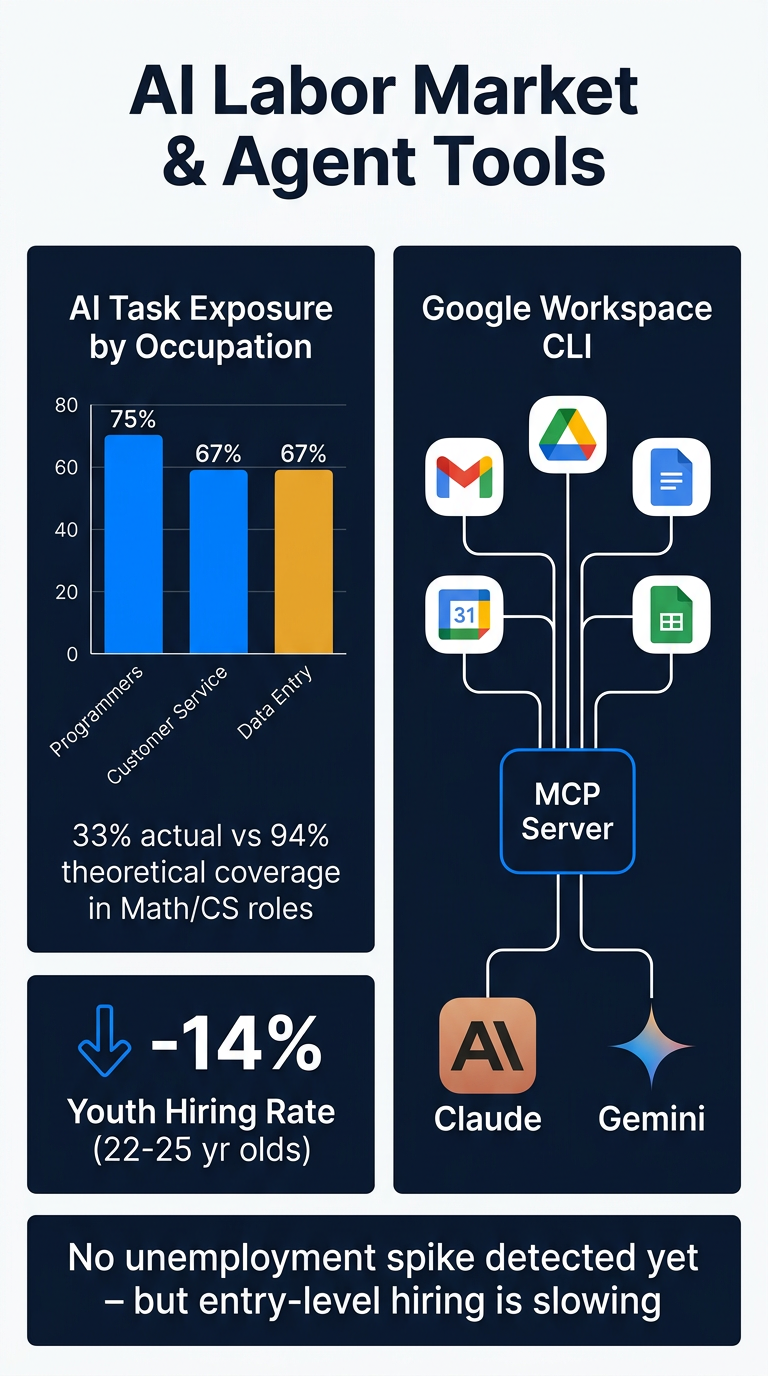
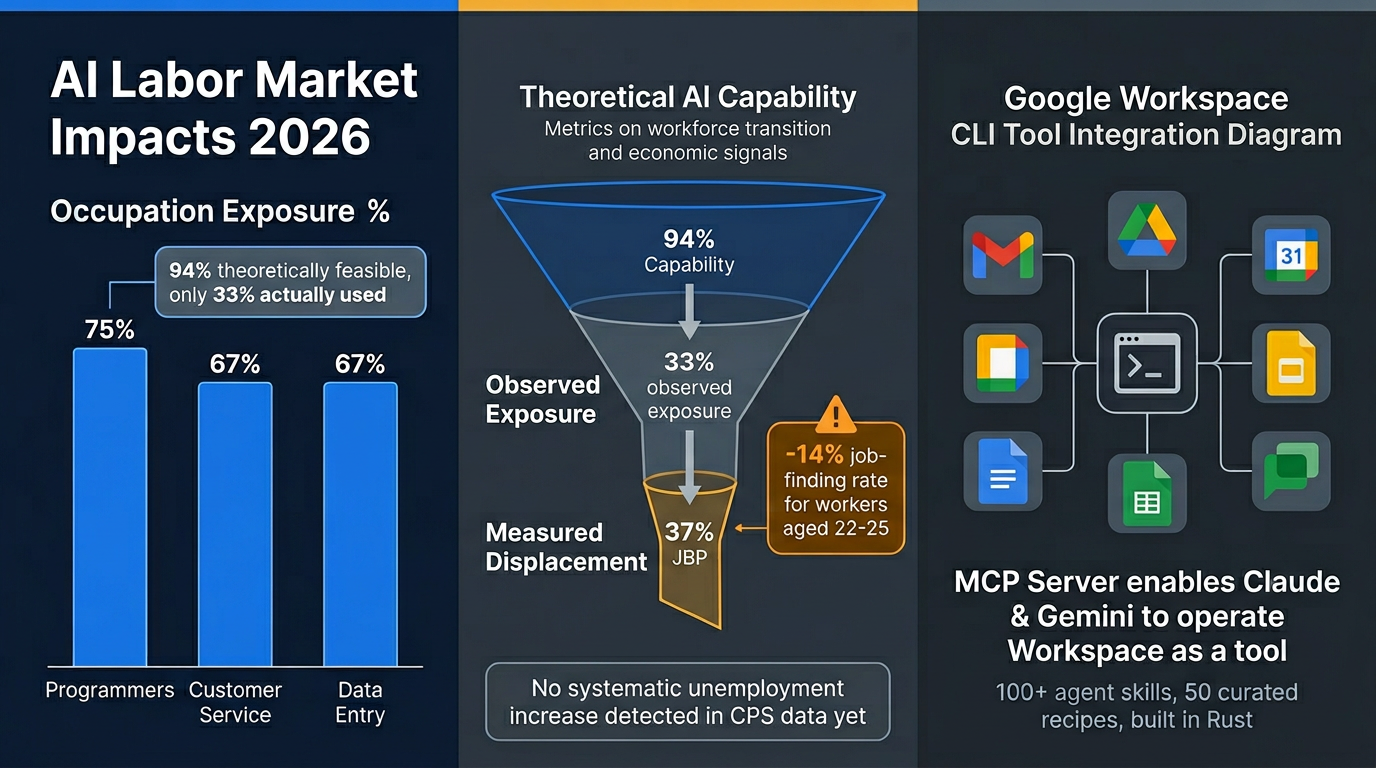
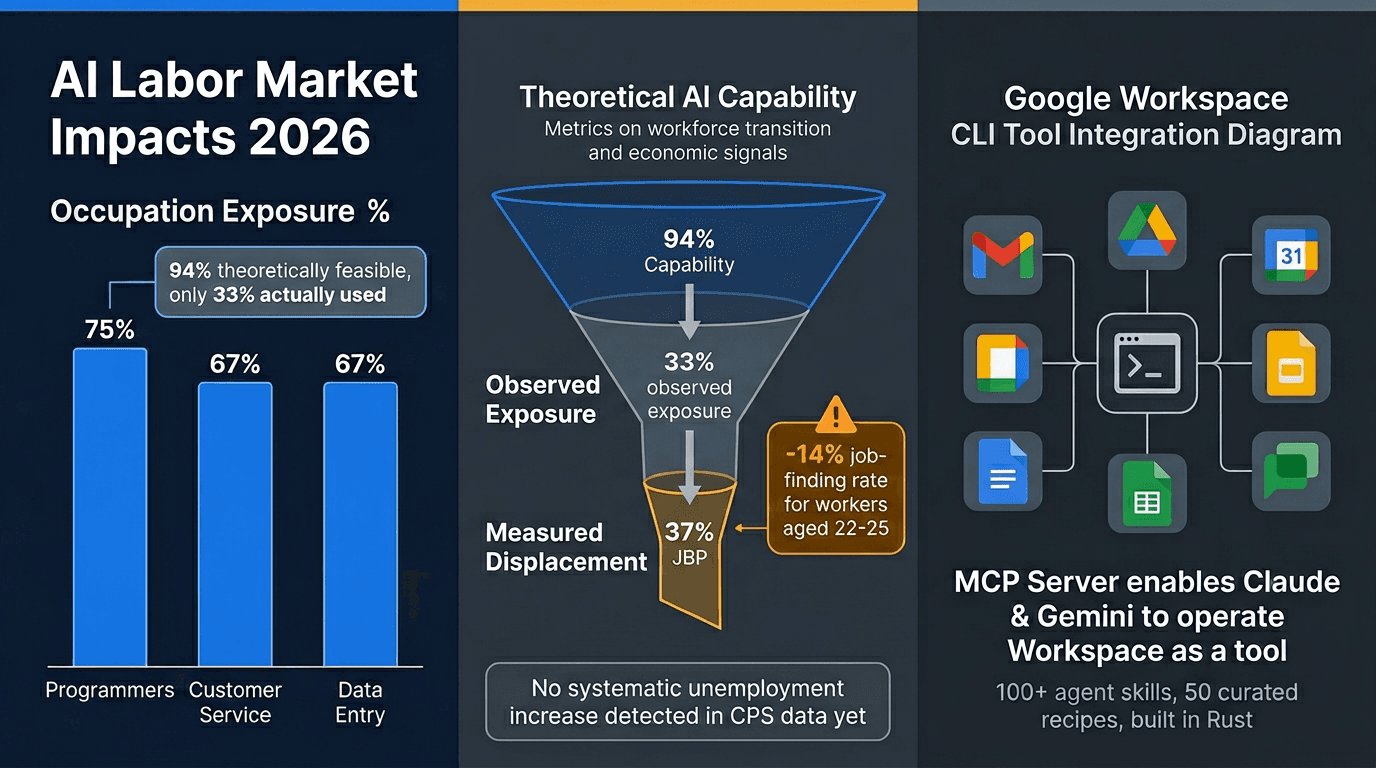
Programmer exposure is highest: Computer programmers top the list at 75% task coverage, followed by customer service representatives and data entry keyers at 67%. This reflects heavy automated API usage in coding and support workflows.
No unemployment signal yet: Analysis of Current Population Survey data shows no systematic increase in unemployment for workers in the most AI-exposed occupations since late 2022 — though the framework could detect differential increases of ~1 percentage point.
Youth hiring slowdown: There is suggestive evidence that hiring of workers aged 22–25 has slowed in AI-exposed occupations, with a 14% drop in job-finding rate compared to 2022. This echoes findings from Brynjolfsson et al. using ADP payroll data.
Massive capability gap remains: Claude currently covers just 33% of all tasks in Computer and Math occupations, despite 94% being theoretically feasible — indicating significant room for future displacement as AI adoption deepens.
Practical Takeaway:
AI displacement is real but uneven and still early-stage. The biggest near-term signal is not mass unemployment but a slowdown in entry-level hiring for young workers in tech-adjacent roles. The gap between theoretical and actual AI capability means the worst disruption may still be ahead.
🛠️ Google Workspace CLI
Google released an official command-line tool for its Workspace APIs, providing a unified interface for Drive, Gmail, Calendar, Sheets, Docs, Chat, and Admin — all from a single binary.
Key Features:
100+ agent skills: Includes
SKILL.mdfiles for every supported API plus higher-level helpers, with 50 curated recipes for common workflows across Gmail, Drive, Docs, Calendar, and Sheets.Built-in MCP server: AI assistants like Claude, Gemini, and others can connect directly to the CLI's MCP server and operate on Google Workspace programmatically, turning the entire Workspace suite into a tool-callable environment for agents.
Dynamic API coverage: Instead of hardcoding endpoints, the CLI generates commands at build time from Google's Discovery Service — automatically picking up new APIs and updates as Google ships them.
Agent-first design: Each skill includes structured metadata, input/output schemas, and example prompts, making it immediately usable by coding agents and AI-powered automation pipelines without custom integration work.
Tech stack: Written in Rust, distributed via npm.
Practical Takeaway:
This is a significant step toward making Google Workspace a first-class agentic environment. Developers and AI agents can now programmatically control the full Workspace suite with minimal setup, enabling powerful automation workflows out of the box.
📰 Other Stories Mentioned (Paywalled)
The following topics were covered but are behind the paid subscriber wall:
- GPT-5.4 launched by OpenAI with native computer use
- Exa Deep — an agent embedded inside every search
- Cognition SWE-1.6 training run preview
- Gemini 3.1 Flash-Lite with major performance gains
- Qwen 3.5 small model series release
- Liquid AI LFM2-24B-A2B model release
- Cursor lands in JetBrains via ACP
- OpenAI Codex Security Agent launch
- OpenAI CoT Controllability research
- Claude Opus hacking its own benchmark eval
📄 Papers Referenced
No direct arxiv.org links were included in the accessible portion of the article. The Brynjolfsson et al. ADP payroll data study is referenced but no direct link was provided.
Key Takeaways
- AI labor displacement is measurable but subtle — watch entry-level hiring, not unemployment rates, as the leading indicator.
- Google Workspace is becoming an agentic platform — the new CLI dramatically lowers the barrier for AI agents to automate real business workflows.
- The capability gap is the story — AI tools are already capable of far more than they're currently being used for, signaling that displacement pressure will intensify as adoption grows.