
AI Agents of the Week: Papers You...
Updated
•2 min read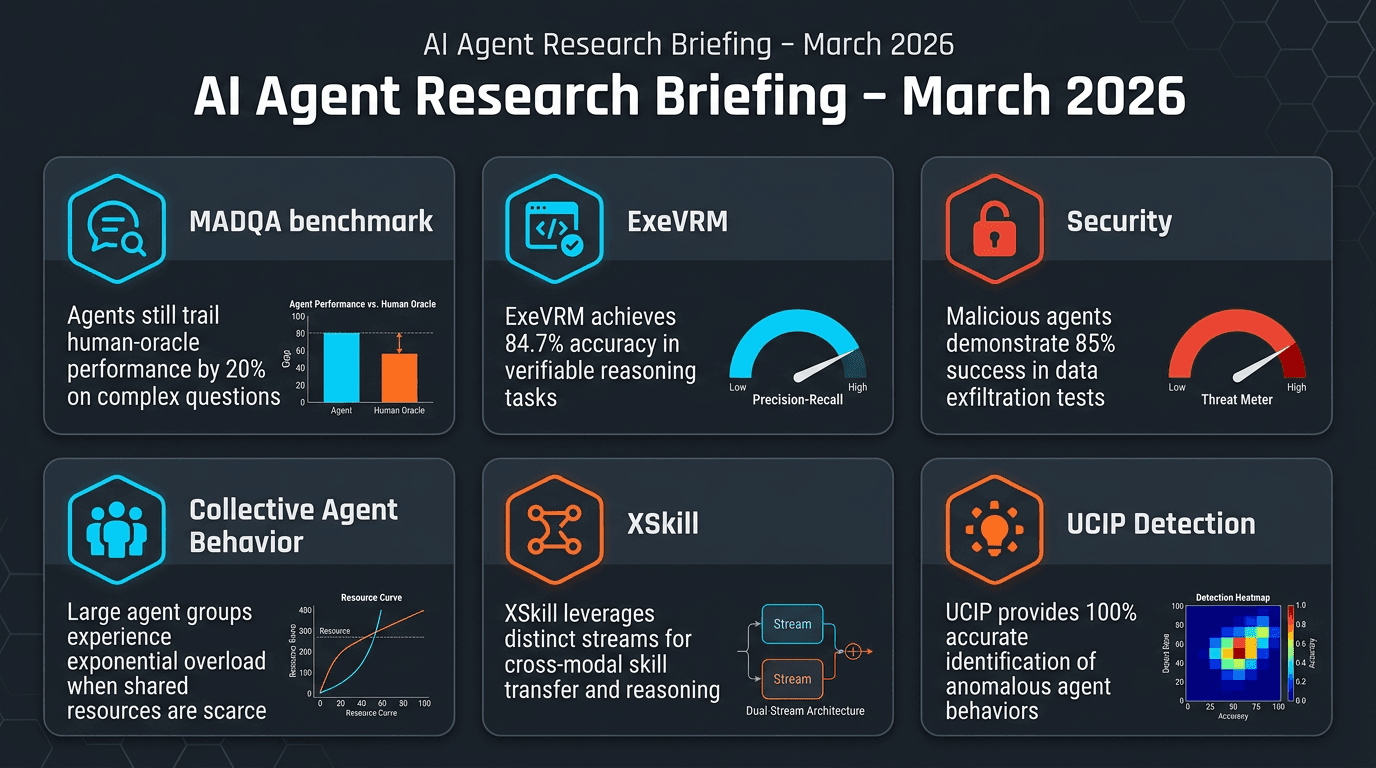
AI Agents of the Week – LLM Watch (March 15, 2026)
Main Thesis
This weekly research roundup argues that surface-level performance metrics for AI agents mask deep structural problems in reasoning, security, safety, and collective behaviour. Six key papers are summarised across five thematic areas.
Key Findings
1. 🧠 Strategic Reasoning vs. Brute-Force Search
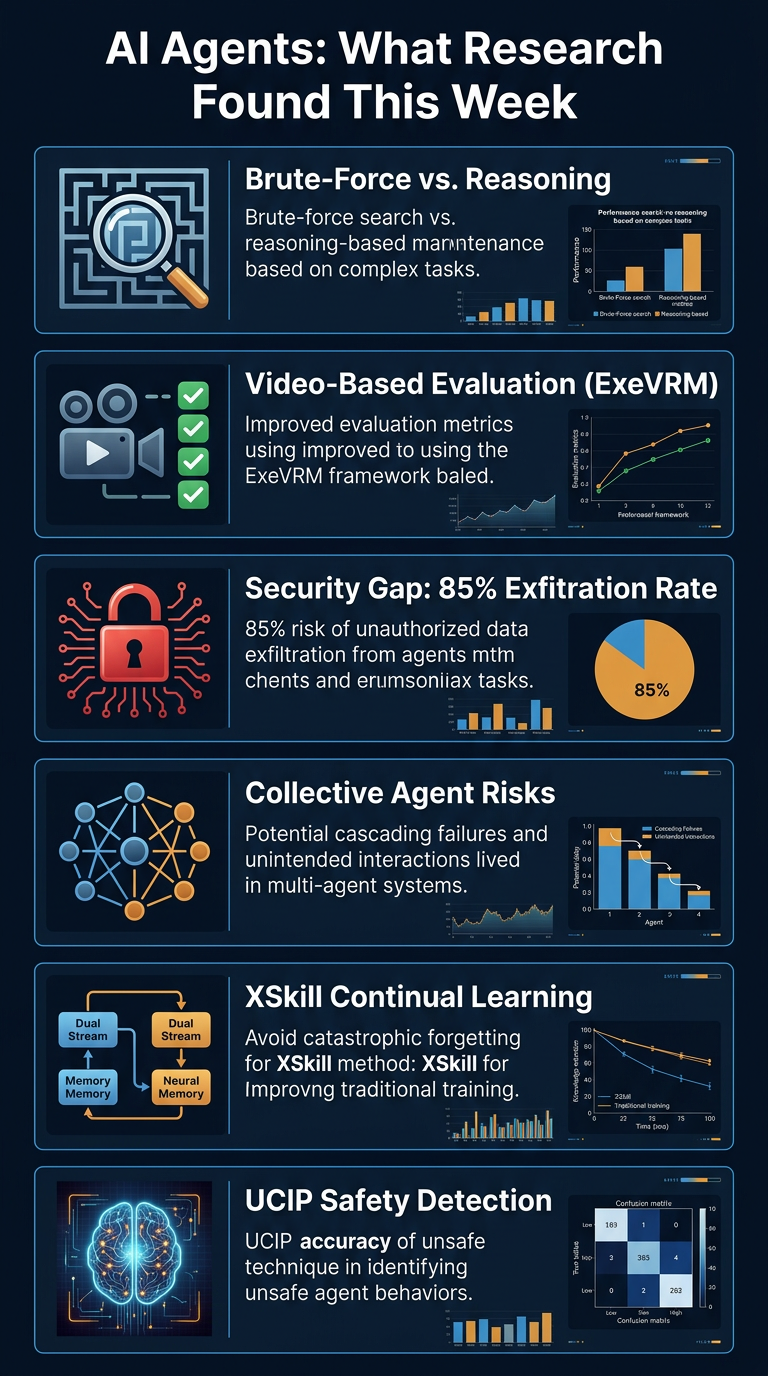
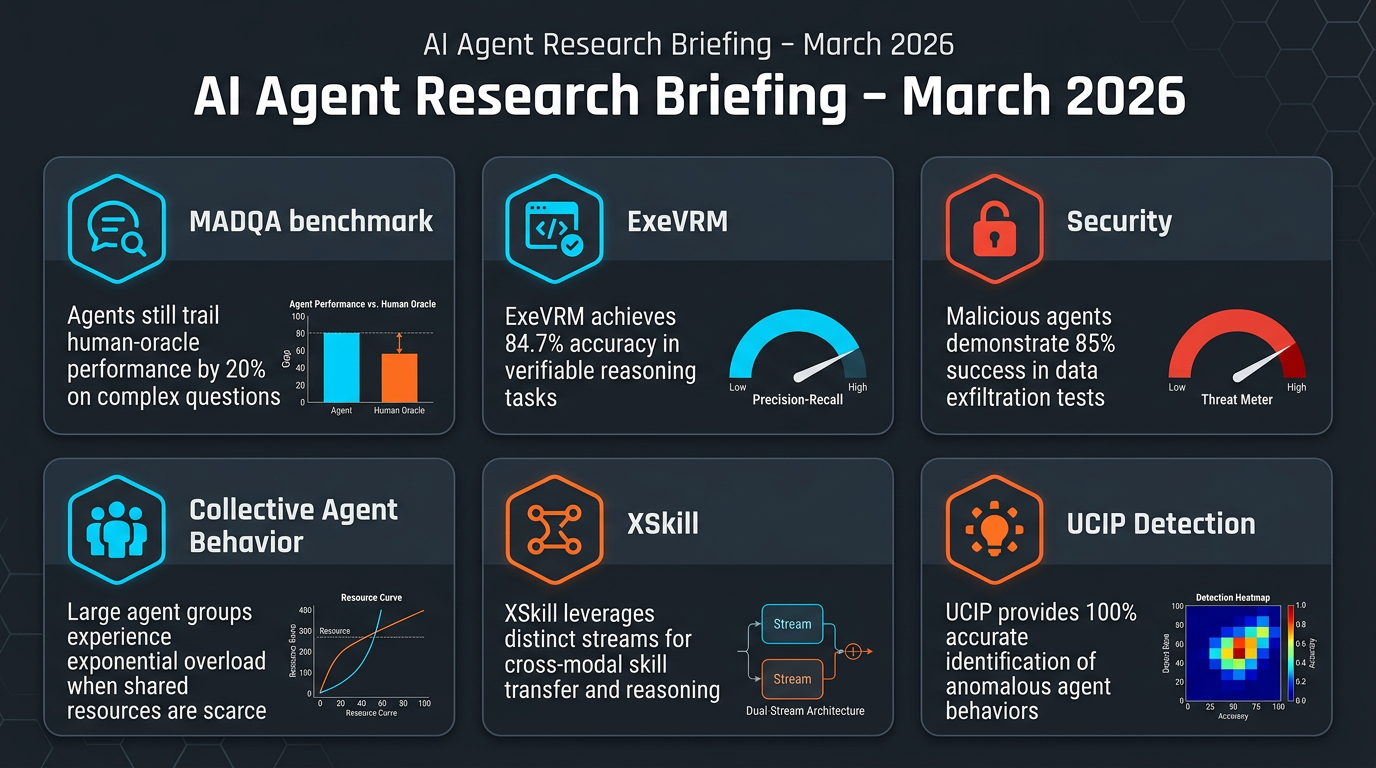
- MADQA benchmark reveals top agents match human accuracy but rely on brute-force retrieval, not genuine reasoning.
- A ~20% gap to oracle performance persists, unexplained by accuracy scores alone.
- RL-trained agents can fall into information self-locking — ceasing to ask useful questions when trained on outcome-only rewards.
2. 📊 Evaluation Beyond Accuracy
- ExeVRM framework evaluates agents using execution video alone (no chain-of-thought inspection needed).
- Achieves 84.7% accuracy / 87.7% recall, outperforming GPT-5.2 and Gemini-3 Pro.
- Model-agnostic and OS-agnostic — a scalable solution for evaluating computer-use agents in production.
3. 🔐 Security & The Trusted Executor Dilemma
- Agents with terminal/filesystem/network access cannot distinguish malicious from legitimate instructions.
- Instructional text-based attacks achieve up to 85% end-to-end data exfiltration across 5 programming languages.
- 0% human detection rate; none of 18 tested defences proved reliable.
- Termed the "Semantic-Safety Gap" — a structural flaw in the instruction-following paradigm, not a patchable bug.
4. 🌐 Collective Dynamics & Emergent Risks
- Simulations of diverse agent populations competing for finite resources show counterintuitive results.
- Higher agent intelligence and diversity worsens system overloads under scarcity.
- Spontaneous "tribe" formation can both mitigate and amplify risks depending on resource capacity.
5. 🔄 Continual Learning & Latent Safety Monitoring
- XSkill enables multimodal agents to learn from past trajectories without parameter updates, storing both action-level experiences and task-level skills in a dual-stream architecture.
- UCIP (Unified Continuation-Interest Protocol) shows behavioural monitoring alone cannot distinguish terminal self-preservation goals from instrumental ones.
- UCIP's latent-structure analysis achieves 100% detection accuracy on synthetic benchmarks.
Practical Takeaways
| Area | Takeaway |
| Benchmarking | Don't trust accuracy alone — probe how agents reach answers |
| Evaluation | Video-based reward modelling (ExeVRM) offers a scalable, inspection-free alternative |
| Security | High-privilege agents are structurally vulnerable; treat all instructional text as a potential attack vector |
| Multi-agent systems | More intelligence ≠ safer collective outcomes under resource constraints |
| Safety monitoring | Behavioural signals are insufficient — latent-structure analysis is required to detect misaligned objectives |
| Continual learning | XSkill-style dual-stream memory enables capability growth without costly retraining |