
You're Spending Six Figures on AI Models. The Bottleneck Is a 4-Minute CI Pipeline — and Nobody's Fixing the Right Thing.
Summary: You're Spending Six Figures on AI Models. The Bottleneck Is a 4-Minute CI Pipeline
Main Thesis
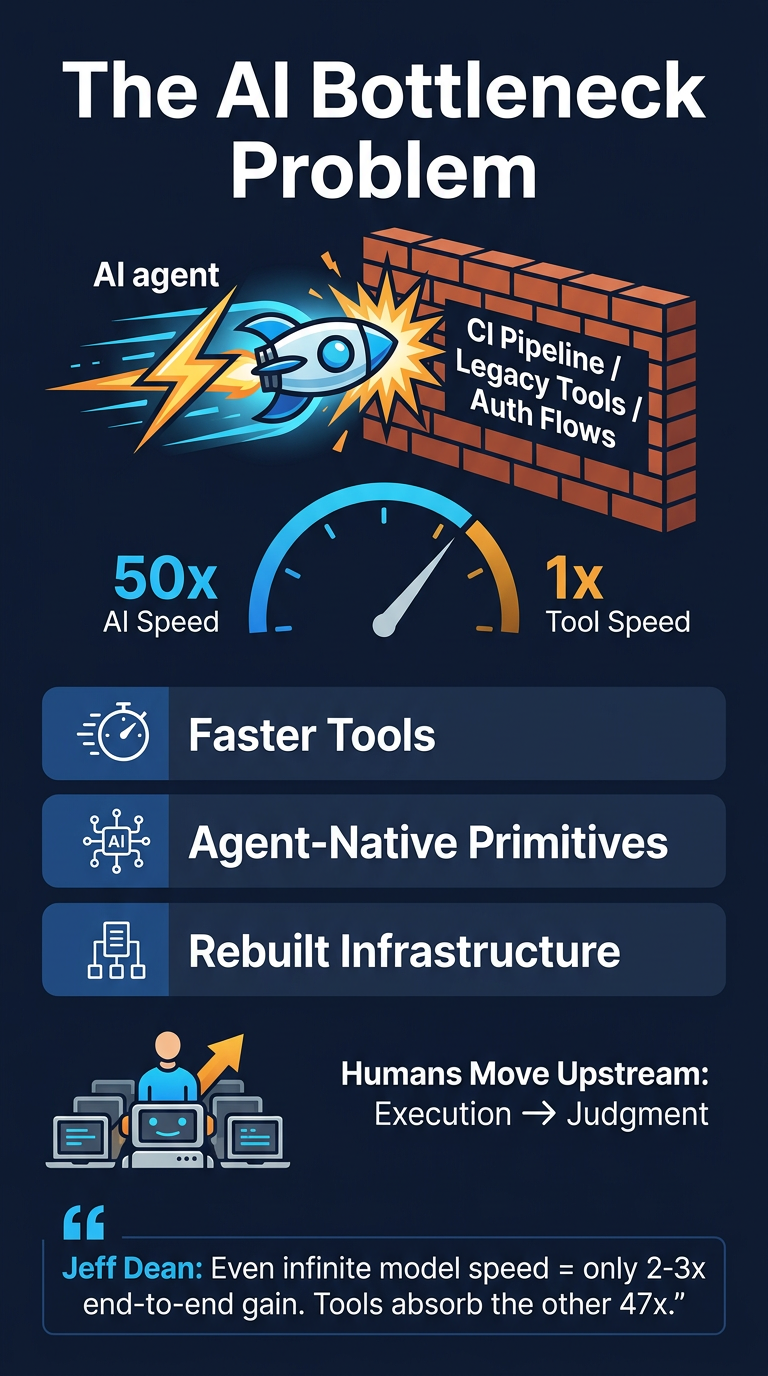
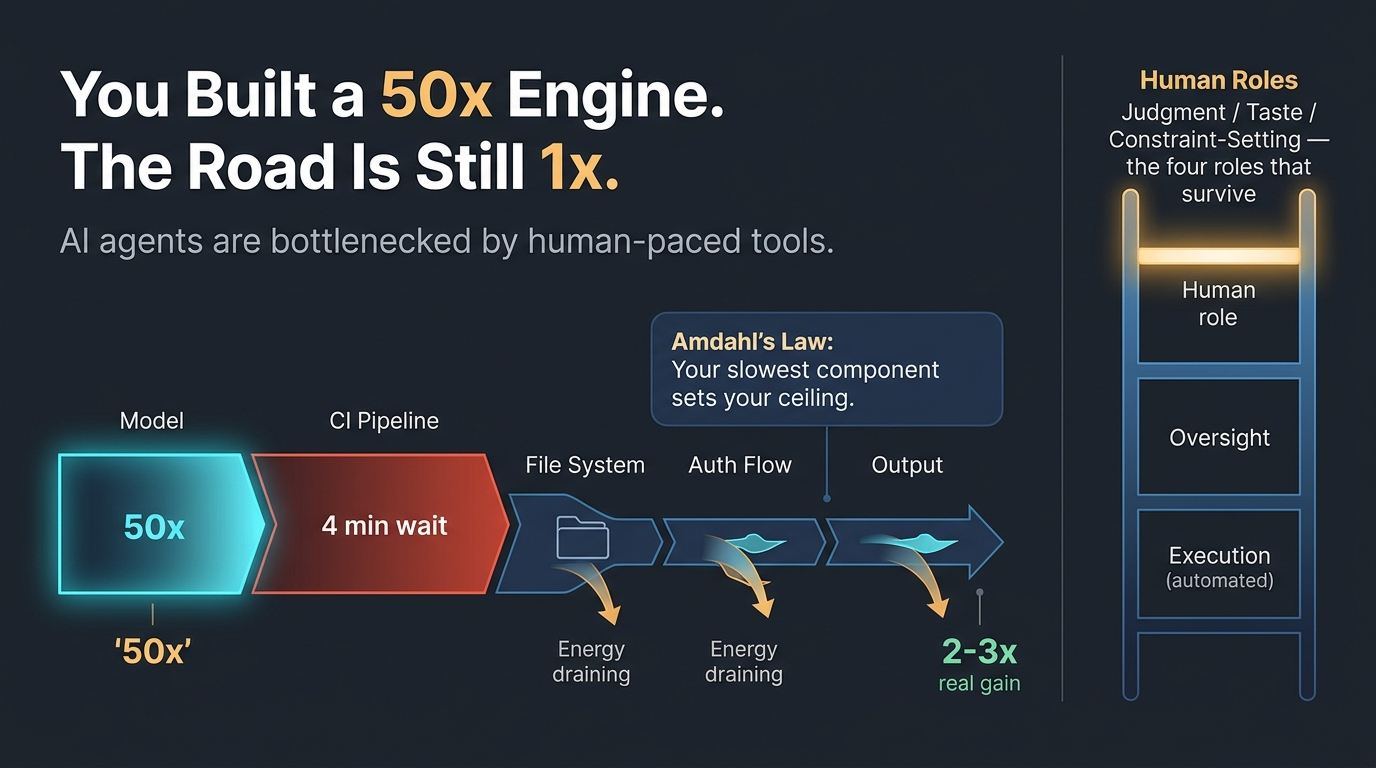
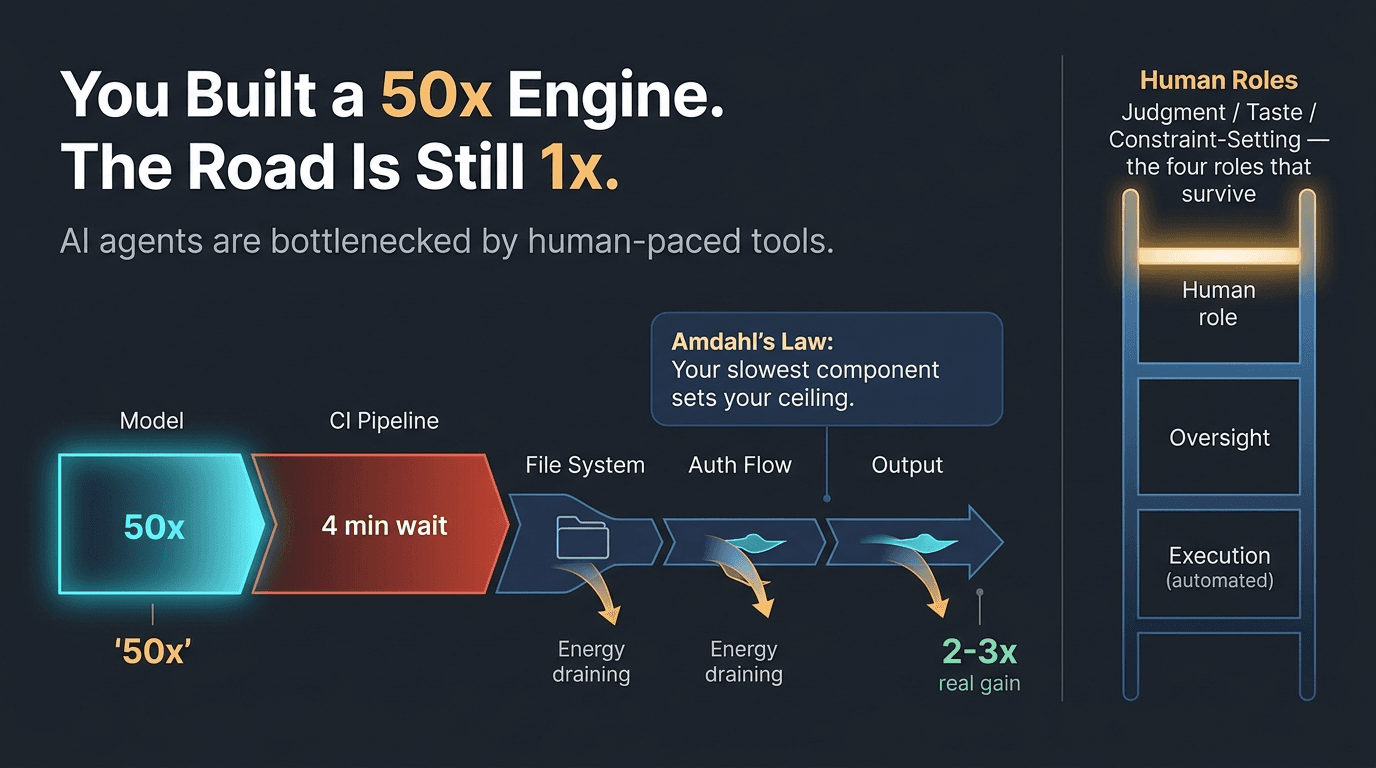
Organizations are investing heavily in AI models that operate 10–50x faster than humans on reasoning tasks, but the real bottleneck isn't the models — it's the surrounding tooling, infrastructure, and workflows that were designed for human-speed operation. Compilers, file systems, CI pipelines, authentication flows, rate limits, and APIs were all calibrated to a brain processing ~3 bits per second. AI agents slam into these constraints and lose most of their speed advantage. As Jeff Dean noted at GTC, even an infinitely fast model only yields a 2–3x end-to-end improvement — the tools absorb the other 47x.
Key Findings
- The bottleneck has shifted: For 50 years, humans were the slowest part of every system. That's no longer true. AI agents are now faster than the tools they use.
- Three-layer rebuild underway: The article identifies a structural rebuild happening across:
- Faster tools — replacing legacy, human-paced interfaces
- Agent-native primitives — APIs, frameworks, and protocols designed for non-human consumers
- Infrastructure — CI/CD, auth, file systems being re-engineered for agent throughput
- The human layer is migrating upstream: Evidence from the METR study and Jellyfish data suggests humans are moving from execution roles to judgment roles — less doing, more directing, evaluating, and deciding.
- Amdahl's Law applies to orgs: The math behind Amdahl's Law (the speedup of a system is limited by its slowest sequential component) explains why fixing the model without fixing the tools yields minimal real-world gains.
Practical Takeaways
The article outlines concrete moves for different roles:
- Engineers: Audit your toolchain for human-paced bottlenecks; prioritize agent-readable outputs and faster feedback loops.
- Leaders: Stop measuring AI ROI only at the model layer — map the full pipeline and find where agent speed is being throttled.
- Platform buyers: Evaluate vendors on agent-native readiness, not just feature lists.
- Company builders: The software being built now is for a consumer with no eyes, no hands, and no need for sleep — design accordingly.
Four Roles That Survive
The piece identifies four human roles that remain valuable above the automation layer (specific roles are behind the paywall), centered on judgment, taste, oversight, and constraint-setting — things agents can execute on, but cannot generate themselves.
Included Prompts (Paid)
- Amdahl Ceiling Calculator — quantify your real AI speed ceiling
- Agent-Readiness Audit — assess your toolchain
- Trait Self-Assessment — identify where you fit in the new stack
- Taste Encoder — translate your judgment into agent-usable constraints